How Changpeng Zhao Built and Lost the World's Largest Crypto Exchange
CZ built Binance from nothing into a $300 billion empire in five years. Then a single tweet toppled FTX, a $4.3 billion DOJ fine followed, and the world's most powerful crypto CEO ended up in handcuffs. This is the full story.
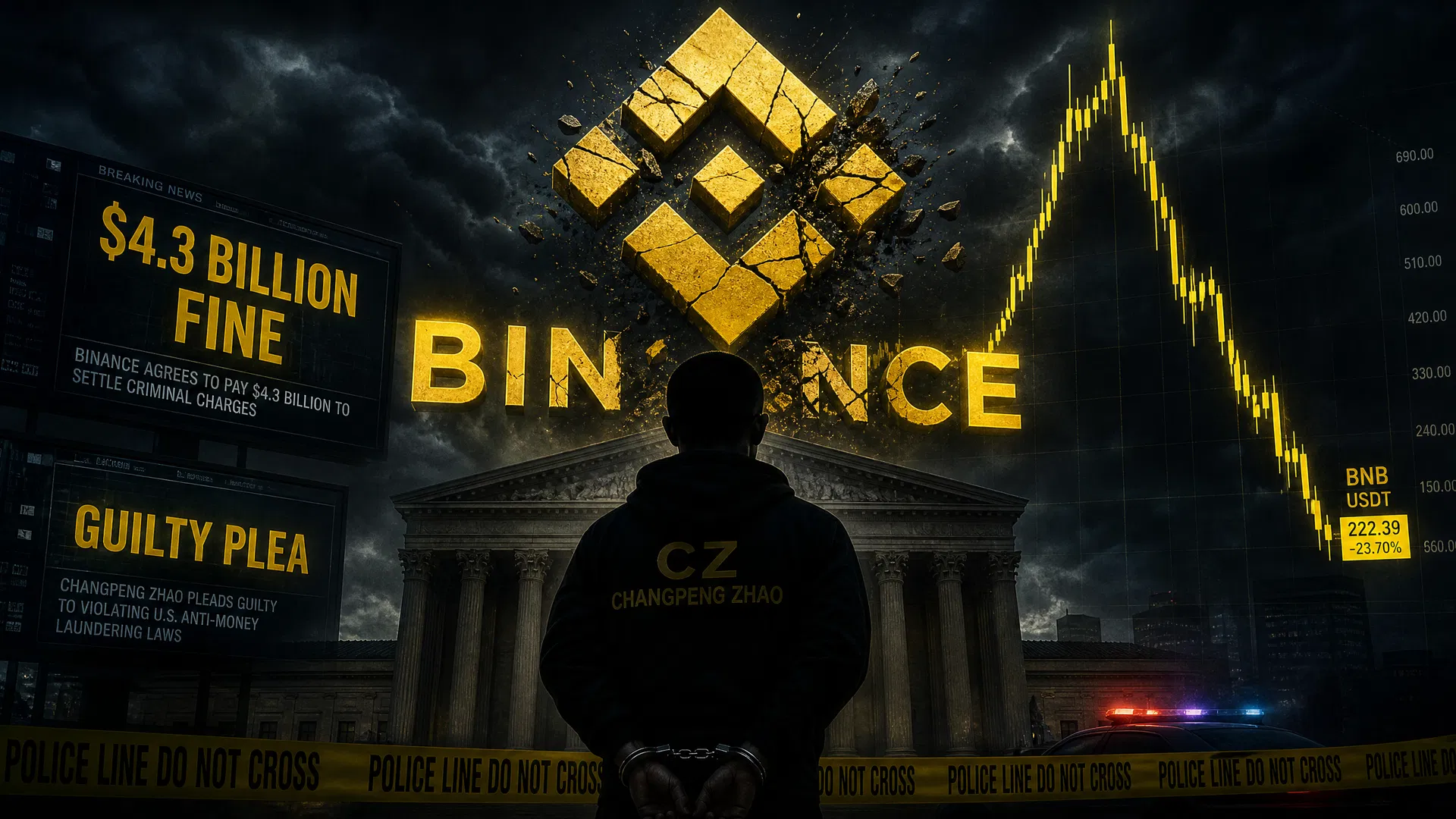
On November 6, 2022, a single tweet changed the course of crypto history. Changpeng Zhao — universally known as CZ — posted that Binance would liquidate its entire holdings of FTT, the native token of rival exchange FTX. Within 72 hours, FTX had collapsed, Sam Bankman-Fried had been arrested, and $8 billion in customer funds had vanished. But CZ's moment of triumph would prove short-lived. Exactly one year later, he stood in a Seattle federal courthouse and pleaded guilty to money laundering violations, agreeing to pay a $50 million fine and step down as CEO of the company he had built from nothing into the world's largest cryptocurrency exchange.
The story of Changpeng Zhao is one of the most remarkable in the history of finance — a Chinese-Canadian immigrant who dropped out of university, worked at McDonald's to fund his studies, and went on to build a $300 billion empire in less than five years. It is also a story about the collision between a 'move fast and break things' Silicon Valley ethos and the hard realities of financial regulation.
Born in Jiangsu province, China in 1977, Zhao emigrated to Canada as a teenager. He studied computer science at McGill University in Montreal, then worked as a developer at the Tokyo Stock Exchange and later at Bloomberg's trading systems division. In 2013, he discovered Bitcoin through a poker game, sold his apartment in Shanghai, and invested the proceeds into crypto. By 2017, he had co-founded Bijie Tech, a company providing exchange software to other crypto platforms — giving him an intimate understanding of how exchanges worked from the inside.
Binance launched in July 2017, just weeks before China banned initial coin offerings. CZ had anticipated the regulatory crackdown and moved the company's servers out of China before the ban took effect. The exchange grew at a speed that defied comprehension: within six months, it had become the world's largest by trading volume, processing over $2 billion per day. Its native token, BNB (Binance Coin), became one of the top five cryptocurrencies by market capitalisation. CZ's personal fortune reached an estimated $96 billion at peak, making him briefly the world's 11th richest person according to Forbes.
Binance's growth strategy was built on regulatory arbitrage — operating in jurisdictions with minimal oversight while serving customers globally, including in the United States. The company had no official headquarters, with CZ famously telling reporters that Binance was 'decentralised' and had no fixed address. In 2019, when US regulators began scrutinising the exchange, Binance announced it would block American users and launched a separate entity, Binance.US. But according to the US Department of Justice, this was a facade: Binance executives, including CZ himself, actively helped high-value 'VIP' customers — who accounted for a disproportionate share of trading volume — to circumvent the restrictions by registering accounts through offshore entities.
The DOJ's investigation, which culminated in November 2023, revealed the full extent of Binance's compliance failures. For years, the exchange had operated with virtually no anti-money laundering controls. Users could open accounts with nothing more than an email address. The exchange never filed a single Suspicious Activity Report with FinCEN, the US financial intelligence unit. Internal communications showed that compliance employees were aware of the problem — one wrote that Binance needed a banner reading 'is washing drug money too hard these days — come to Binance, we got cake for you.' Illicit actors used the platform to process proceeds from ransomware attacks, darknet markets, and child sexual abuse material. Between January 2018 and May 2022, Binance facilitated over $898 million in trades between US users and users in Iran, in violation of US sanctions law.
On November 21, 2023, Binance pleaded guilty to violations of the Bank Secrecy Act, failure to register as a money transmitting business, and the International Emergency Economic Powers Act. The total financial penalty was $4.316 billion — one of the largest corporate penalties in US history. CZ personally pleaded guilty to failing to maintain an effective AML programme and agreed to pay a $50 million fine. He also resigned as CEO, with Richard Teng, a former Singapore financial regulator, taking over the role. Prosecutors had sought a 36-month prison sentence, arguing that CZ had violated US law 'on an unprecedented scale' and operated on a 'Wild West' model. The sentencing guidelines called for 12 to 18 months. On April 30, 2024, US District Judge Richard Jones sentenced CZ to four months in federal prison — far below what prosecutors had requested, but a historic first: the founder of the world's largest crypto exchange, in handcuffs.
The contrast with Sam Bankman-Fried's 25-year sentence is instructive. Legal analysts noted that while both men ran crypto empires that violated US law, the nature of their crimes differed fundamentally. SBF was convicted of fraud — he stole customer funds and lied about it. CZ's crimes were regulatory failures: he allowed Binance to be used for money laundering by not implementing adequate controls, but there was no evidence he personally stole from customers. 'CZ's case seems to focus on regulatory and compliance failures, while SBF's case hinges on direct financial misconduct and deception,' said Braden Perry, a former senior CFTC trial lawyer. 'Compliance failures, while serious, might be seen as a failure of oversight rather than active malfeasance.'
CZ served his four-month sentence at a minimum-security federal prison in California and was released in September 2024. He retains an estimated 90% stake in Binance, which — despite the guilty plea, the $4.3 billion fine, and the loss of its founder — remains the world's largest cryptocurrency exchange by trading volume. In early 2025, CZ announced he was focusing on investments in AI and blockchain education, and had been appointed as an adviser to several national governments on crypto regulation. The man who built the world's largest crypto exchange, watched it nearly collapse under the weight of its own regulatory failures, and served time in federal prison, was already planning his next act.
The Binance saga raises profound questions about the future of crypto regulation. The exchange's survival — and continued dominance — after a $4.3 billion fine and a criminal guilty plea suggests that the network effects of being the world's largest exchange are almost impossible to overcome, even through legal action. For regulators, the lesson is that fines alone may not be sufficient to change behaviour in an industry where the profits from non-compliance can dwarf the penalties. For investors and traders, it is a reminder that the exchange holding their funds is not just a technology platform, but a regulated financial institution with legal obligations — and that when those obligations are ignored, the consequences can be severe.
The Tweet That Toppled FTX
On November 6, 2022, CZ posted a seemingly routine business announcement: Binance would liquidate its FTT holdings — approximately $530 million worth — citing 'recent revelations' about FTX's balance sheet. The post was a grenade thrown into the crypto market. FTT's price immediately began to fall as traders rushed to exit. Within 24 hours, FTX was facing a bank run of historic proportions, with over $6 billion in withdrawal requests in a single day.
CZ later denied that he had intended to destroy FTX, claiming he was simply managing risk after a CoinDesk report revealed that Alameda Research, FTX's sister trading firm, held a balance sheet dominated by FTT tokens — a circular arrangement that suggested FTX's finances were far weaker than they appeared. But the timing and the public nature of the announcement — rather than a quiet over-the-counter sale — led many in the industry to conclude that CZ had deliberately weaponised his position to eliminate his most dangerous rival.
What is not in dispute is the result. FTX collapsed within 72 hours. SBF resigned as CEO on November 11, 2022. The exchange filed for bankruptcy the same day. Eight billion dollars in customer funds were missing. And CZ, who had briefly offered to acquire FTX before withdrawing after a cursory look at the books, emerged as the last man standing in the exchange wars — at least temporarily.
From Shanghai Apartment to $96 Billion Fortune
CZ's origin story has become one of the founding myths of the crypto industry. Born in Jiangsu province in 1977, he moved to Canada as a teenager when his father, a professor, was exiled during a political campaign. He studied computer science at McGill University, working at McDonald's and as a night-shift waiter to fund his education. After graduating, he worked at the Tokyo Stock Exchange and Bloomberg's trading systems division, developing expertise in high-frequency trading infrastructure.
In 2013, he encountered Bitcoin at a poker game in Shanghai. Convinced of its potential, he sold his apartment and invested the proceeds into crypto. By 2017, he had co-founded Bijie Tech, which provided white-label exchange software to other crypto platforms — giving him an intimate understanding of exchange architecture, liquidity mechanics, and the technical challenges of scaling a trading platform.
When he launched Binance in July 2017, he had a clear competitive advantage: he understood exchanges better than almost anyone in the industry. The platform's user interface was cleaner, its fees were lower (0.1% compared to competitors' 0.2-0.5%), and its listing process was faster. Within six months, Binance was processing more trades than any other exchange in the world.
The Regulatory Arbitrage Machine
Binance's business model was, from the beginning, built on a deliberate strategy of regulatory ambiguity. The company had no official headquarters — CZ told journalists that Binance was 'decentralised' and existed wherever its employees happened to be. This was not merely philosophical: it was a legal strategy designed to make it difficult for any single regulator to assert jurisdiction over the exchange.
When the US began scrutinising Binance in 2019, the company announced it would block American users and launched Binance.US as a separate, regulated entity. But according to the DOJ, this was a facade. Internal communications showed that Binance executives, including CZ, actively helped high-value 'VIP' customers — who accounted for a disproportionate share of trading volume — to circumvent the restrictions. Binance employees called US VIPs to encourage them to register accounts through offshore entities, effectively maintaining their access to the main Binance platform while creating the appearance of compliance.
The strategy worked for years. By the time US regulators caught up with Binance, the exchange had already generated over $1.6 billion in profit from US customers alone. The $4.3 billion fine, while historic, represented a fraction of the total revenue generated during the period of non-compliance.
The $4.3 Billion Guilty Plea
The DOJ's investigation into Binance was one of the most complex financial crime cases in US history, involving the Department of Justice, the CFTC, FinCEN, OFAC, and the IRS Criminal Investigation division. The investigation revealed that Binance had processed transactions for users in sanctioned jurisdictions including Iran, Cuba, Syria, and Russian-occupied regions of Ukraine. It had facilitated transactions for ransomware operators, darknet markets, and other criminal enterprises. And it had done so while deliberately avoiding the implementation of know-your-customer and anti-money laundering controls that are standard in regulated financial institutions.
On November 21, 2023, Binance pleaded guilty to three federal charges: violation of the Bank Secrecy Act, failure to register as a money transmitting business, and violation of the International Emergency Economic Powers Act. The total financial penalty was $4.316 billion — comprising $2.51 billion in forfeiture and a $1.8 billion criminal fine. CZ personally pleaded guilty to failing to maintain an effective AML programme and agreed to pay a $50 million personal fine.
Attorney General Merrick Garland called it a historic moment: 'Binance became the world's largest cryptocurrency exchange in part because of the crimes it committed — now it is paying one of the largest corporate penalties in US history.' Treasury Secretary Janet Yellen added: 'Binance turned a blind eye to its legal obligations in the pursuit of profit. Its wilful failures allowed money to flow to terrorists, cybercriminals, and child abusers through its platform.'
Four Months in Federal Prison
On April 30, 2024, CZ appeared before US District Judge Richard Jones in a Seattle federal courthouse wearing a dark navy suit. Prosecutors had sought 36 months, arguing that CZ had violated US law 'on an unprecedented scale' and that his sentence should reflect the gravity of allowing Binance to become a 'playground for bad actors.' The defence had asked for five months of probation.
'I'm sorry,' CZ told the judge. 'I believe the first step of taking responsibility is to fully recognise the mistakes. Here I failed to implement an adequate anti-money laundering program... I realise now the seriousness of that mistake.' Judge Jones sentenced him to four months in federal prison — below the 12-to-18-month sentencing guidelines, but a historic outcome nonetheless.
CZ served his sentence at a minimum-security federal correctional institution in Lompoc, California, and was released in September 2024. He remains one of the wealthiest people in the world, with an estimated 90% stake in Binance — a stake worth tens of billions of dollars even after the fine and the reputational damage of a criminal conviction.
Binance After CZ: Survival Against the Odds
The conventional wisdom in financial regulation is that a criminal guilty plea is fatal to a financial institution. The collapse of Arthur Andersen after its indictment in the Enron scandal is the standard reference point. Binance has defied this precedent entirely. Under its new CEO Richard Teng — a former chief regulatory officer at the Abu Dhabi Global Market and a seasoned financial regulator — Binance has continued to grow its market share.
By mid-2026, Binance still accounts for approximately 40-45% of global cryptocurrency trading volume, processing over $60 billion per day. It has obtained regulatory licences in multiple jurisdictions, including France, Spain, Italy, and several Middle Eastern countries. The exchange has invested heavily in compliance infrastructure, hiring hundreds of compliance professionals and implementing the KYC and AML controls that were conspicuously absent during the CZ era.
The survival of Binance raises uncomfortable questions for regulators. If the world's largest crypto exchange can absorb a $4.3 billion fine, a criminal guilty plea, and the imprisonment of its founder — and emerge with its market position intact — it suggests that the network effects of being the dominant exchange are almost impossible to overcome through legal action alone. For users, the lesson is more straightforward: the exchange holding your funds is a regulated financial institution, and the quality of its compliance programme matters as much as its trading fees.
What Comes Next for CZ
Since his release from prison in September 2024, CZ has been characteristically active. He has announced investments in AI infrastructure companies, blockchain education platforms, and a biotech startup focused on longevity research. He has been appointed as an adviser on cryptocurrency regulation to the governments of Kyrgyzstan, Pakistan, and several other emerging market nations — a role that carries a certain irony given his recent criminal conviction for regulatory violations.
In early 2025, CZ published a lengthy essay on his personal blog reflecting on the Binance years. He acknowledged that the company had grown faster than its compliance infrastructure could handle, and that he had prioritised growth over regulatory compliance in ways that, in retrospect, were clearly wrong. He stopped short of expressing regret about the broader Binance model, instead framing the compliance failures as the inevitable growing pains of a genuinely new type of financial institution operating in a regulatory vacuum.
Whether CZ will attempt to return to the crypto exchange business remains unclear. US law bars him from serving as an officer or director of a money services business, and the terms of his plea agreement include ongoing cooperation with US authorities. But in an industry that has consistently rewarded second acts — and where the line between visionary and criminal has often been blurry — it would be unwise to assume that the CZ chapter of crypto history is closed.
Useful Resources
DOJ Press Release: Binance Guilty Plea
https://www.justice.gov/archives/opa/pr/binance-and-ceo-plead-guilty-federal-charges-4b-resolution
CNBC: CZ Sentenced to 4 Months
https://www.cnbc.com/2024/04/30/binance-founder-changpeng-zhao-cz-sentenced-to-four-months-in-prison-.html
Compare Binance Alternatives on ExchangeRank
/rankings
Related Articles

Binance Restarts Withdrawals After $6.3 Billion Hack—95% Replaced, Not Recovered
November 1, 2026 · 5 min read

Australia's Crypto Licensing Deadline Is Weeks Away — What Exchanges Must Do Before October 1
September 7, 2026 · 7 min read

The CLARITY Act: America's Most Important Crypto Law Is Racing Against an August 10 Deadline
July 27, 2026 · 7 min read

Binance Withdraws MiCA Application in Greece — No EU License as of July 1, 2026
June 24, 2026 · 8 min read