Coinbase vs. SEC: From $100M Fine to Landmark Dismissal
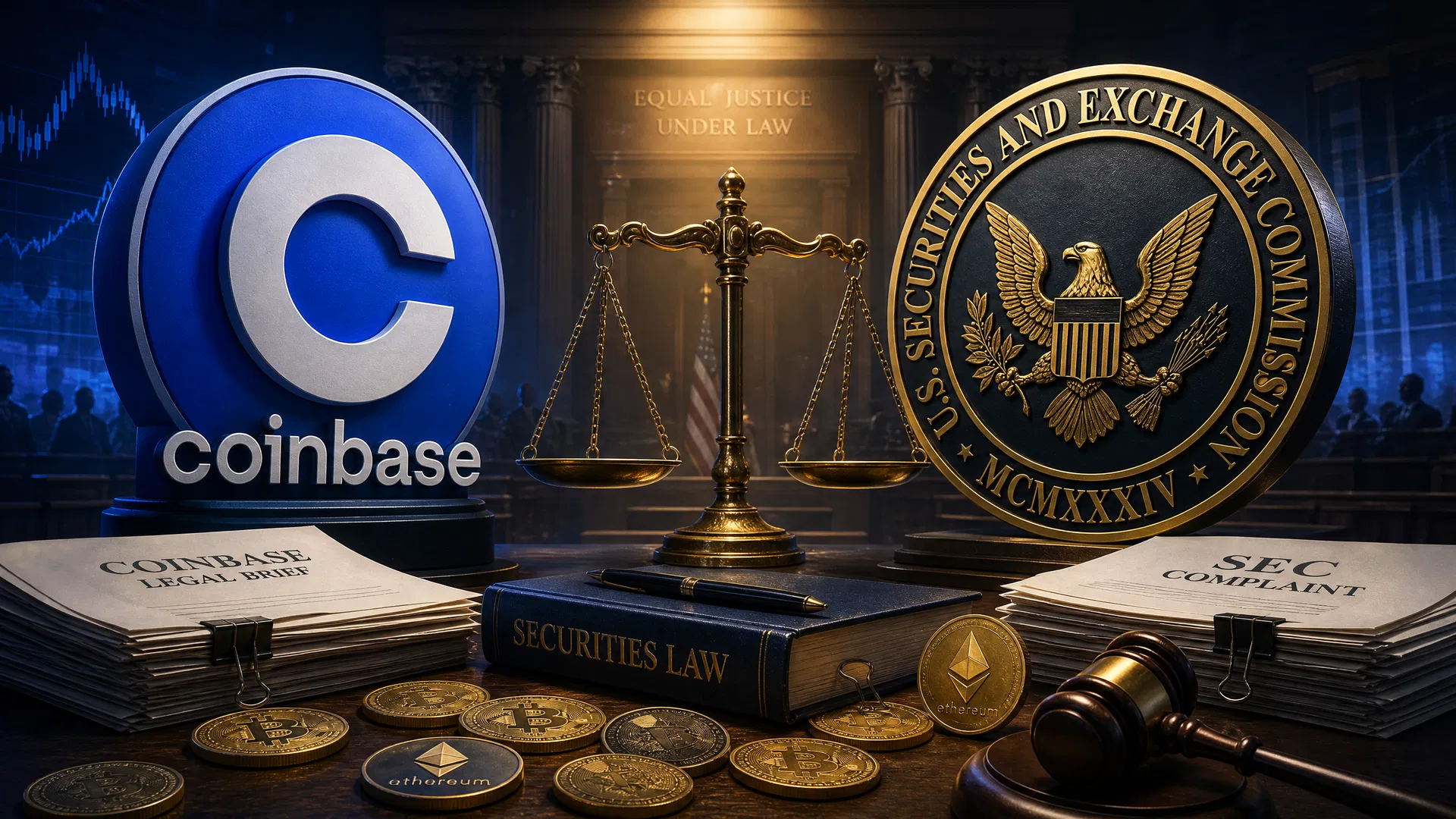
In June 2023, the SEC sued Coinbase for operating as an unregistered securities exchange — the most significant regulatory challenge in the exchange's history. After 20 months of courtroom battles, the Trump administration's SEC dropped the case entirely in February 2025. This is the full story.
Coinbase: America's Crypto Giant
Coinbase was founded in June 2012 by Brian Armstrong, a former Airbnb engineer who had read the Bitcoin white paper and saw an opportunity to build the most trusted on-ramp to the cryptocurrency ecosystem. Starting in a Y Combinator batch with just $150,000 in seed funding, the company grew to become the dominant US crypto exchange — the place where millions of Americans bought their first Bitcoin.
By the time Coinbase went public via direct listing on Nasdaq in April 2021, the company was valued at over $85 billion on its first day of trading. The IPO was a watershed moment for the entire crypto industry: a legitimisation signal that digital assets had arrived in mainstream finance. Coinbase was not a shadowy offshore operation — it was a publicly traded, audited, regulated company with over 100 million verified users.
Yet that very legitimacy made Coinbase a target. As the most prominent US crypto exchange, it became the focal point for a regulatory debate that had been building for years: were the tokens traded on platforms like Coinbase 'securities' under US law? If so, Coinbase was operating as an unregistered securities exchange — a serious violation. The SEC, under Chair Gary Gensler, decided to find out in court.
The $100 Million NYDFS Settlement: A Warning Shot (January 2023)
Before the SEC filed its lawsuit, Coinbase faced a significant regulatory action from the New York Department of Financial Services (NYDFS). On January 4, 2023, the NYDFS announced a $100 million settlement with Coinbase for 'significant failures in its compliance program' that violated New York Banking Law.
The settlement revealed systemic problems in Coinbase's anti-money laundering (AML) infrastructure. The NYDFS found that Coinbase had failed to screen tens of millions of transactions, allowed a backlog of over 100,000 unreviewed transaction monitoring alerts, and had inadequate customer due diligence processes. In one case highlighted in the consent order, a single employee transferred more than $150 million from a corporate account into a Coinbase account without adequate checks.
Under the settlement, Coinbase paid a $50 million civil penalty to New York State and committed to investing an additional $50 million over the following two years to overhaul its compliance infrastructure. The exchange also agreed to the appointment of an independent monitor to oversee its remediation efforts. The NYDFS settlement was a serious blow — but it was only the opening act.
The SEC Strikes: June 6, 2023
On June 6, 2023, the SEC filed a complaint against Coinbase, Inc. and its holding company Coinbase Global, Inc. in the US District Court for the Southern District of New York. The complaint alleged that Coinbase had, since at least 2019, operated as an unregistered national securities exchange, broker, and clearing agency — making billions of dollars 'unlawfully facilitating the buying and selling of crypto asset securities.'
The SEC's theory was sweeping: it argued that at least 13 crypto assets traded on Coinbase's platform — including tokens such as SOL, ADA, MATIC, FIL, SAND, AXS, CHZ, FLOW, ICP, NEAR, VGX, DASH, and NEXO — were securities under the Howey test, a legal standard dating to a 1946 Supreme Court case. Because these assets were securities, the SEC argued, Coinbase needed to register as a national securities exchange, broker-dealer, and clearing agency — functions it had combined without any registration.
The complaint also targeted Coinbase's staking-as-a-service program, alleging that it constituted an unregistered securities offering. Through this program, Coinbase pooled customers' stakeable crypto assets, performed blockchain validation services, and distributed a portion of the rewards — a structure the SEC argued met the definition of an investment contract.
'We allege that Coinbase, despite being subject to the securities laws, commingled and unlawfully offered exchange, broker-dealer, and clearinghouse functions,' said SEC Chair Gary Gensler. 'Coinbase's alleged failures deprive investors of critical protections, including rulebooks that prevent fraud and manipulation, proper disclosure, safeguards against conflicts of interest, and routine inspection by the SEC.'
Coinbase's response was defiant. CEO Brian Armstrong called the lawsuit 'a disappointing development' and argued that the company had repeatedly sought regulatory clarity from the SEC — including filing a formal rulemaking petition in July 2022 — only to be met with silence and then a lawsuit. 'We asked the SEC to provide clarity on which digital assets are securities, and they sued us instead,' Armstrong said.
The Legal Battle: 2023–2024
The case quickly became one of the most closely watched in crypto legal history. Coinbase mounted a vigorous defence, arguing that the SEC was attempting to apply securities law to a new asset class without proper rulemaking — a process that requires public notice, comment periods, and reasoned explanation. In October 2023, the SEC formally denied Coinbase's rulemaking petition, a decision Coinbase immediately appealed to the Third Circuit Court of Appeals.
In January 2024, a hearing in the Southern District of New York tackled the central question: whether the tokens on Coinbase's platform were securities. Judge Katherine Polk Failla, presiding over the case, allowed the SEC's claims to proceed in March 2024, ruling that the SEC had adequately alleged that the tokens in question were investment contracts. Coinbase filed for an interlocutory appeal — a rare procedural move to challenge the ruling before trial — which the court granted in January 2025.
Meanwhile, the parallel Third Circuit case produced a significant ruling on January 13, 2025. The appeals court found that the SEC had failed to adequately explain its decision to deny Coinbase's rulemaking petition, and remanded the matter back to the SEC for a more thorough response. The ruling was a partial victory for Coinbase and increased pressure on the SEC to articulate a coherent regulatory framework for crypto assets rather than relying solely on enforcement actions.
The Trump Effect: A New SEC, A New Approach
The political landscape shifted dramatically in January 2025 when Donald Trump was inaugurated as President of the United States. Trump had campaigned on making the US 'the crypto capital of the world' and had received significant financial support from the crypto industry during the election. Gary Gensler, the architect of the SEC's aggressive crypto enforcement strategy, resigned as SEC Chair effective January 20, 2025.
On January 21, 2025, the SEC announced the formation of a Crypto Task Force, dedicated to developing 'a comprehensive and clear regulatory framework for crypto assets.' The task force was led by Commissioner Hester Peirce, long known as 'Crypto Mom' for her scepticism of the SEC's enforcement-first approach to digital assets.
Acting Chairman Mark T. Uyeda signalled a fundamental shift in philosophy: 'For the last several years, the Commission's views on crypto have been largely expressed through enforcement actions without engaging the general public. It's time for the Commission to rectify its approach and develop crypto policy in a more transparent manner.'
Dismissal: February 27, 2025
On February 21, 2025, Coinbase announced that the SEC had informed the company of its intention to drop the lawsuit. Six days later, on February 27, 2025, the SEC made it official: the Commission filed a joint stipulation with Coinbase to dismiss the civil enforcement action with prejudice — meaning the case could not be refiled.
The dismissal was unconditional. Coinbase paid no fine, agreed to no consent order, and made no admissions of wrongdoing. The SEC explicitly stated that its decision 'does not reflect the Commission's position on any other case' and rested on the judgment that dismissal would 'facilitate the Commission's ongoing efforts to reform and renew its regulatory approach to the crypto industry.'
Brian Armstrong celebrated the outcome on social media: 'We fought this case and won. The SEC sued us without clear rules, and we refused to settle. Today is a victory not just for Coinbase, but for the entire crypto industry and for the rule of law.' The stock market agreed — Coinbase shares (COIN) rose sharply on the news.
The dismissal was widely interpreted as a watershed moment for US crypto regulation. After years of 'regulation by enforcement,' the SEC was signalling a willingness to engage with the industry through rulemaking rather than litigation. For exchanges like Coinbase, it represented the end of an era of existential legal uncertainty.
What the Case Means for Crypto Regulation
The Coinbase vs. SEC case was never just about one exchange. It was a proxy battle for the fundamental question of how the United States would regulate the crypto industry. The SEC's theory — that most crypto tokens are securities and that exchanges listing them must register — would have had industry-wide implications, potentially requiring every major crypto exchange to restructure its operations or exit the US market.
The dismissal does not resolve the underlying legal questions. The Howey test still applies to crypto assets, and the SEC retains the authority to pursue cases against token issuers and fraudulent actors. What has changed is the SEC's willingness to use enforcement as its primary regulatory tool against exchanges that are trying to operate legitimately.
For European users, the contrast with the EU's MiCA framework is instructive. While the US spent two years in courtroom battles over whether existing securities law applied to crypto, Europe built an entirely new regulatory framework from scratch. MiCA, which came into full effect in December 2024, provides clear rules for crypto asset service providers — including exchanges — without requiring them to navigate decades-old securities law designed for a pre-digital world.
The Coinbase case also highlighted the importance of regulatory compliance infrastructure. The NYDFS settlement that preceded the SEC lawsuit revealed genuine deficiencies in Coinbase's AML systems — deficiencies that cost the company $100 million and damaged its reputation. Whatever the outcome of the SEC litigation, the lesson for exchanges is clear: compliance is not optional, and the cost of cutting corners is measured in hundreds of millions of dollars and years of legal distraction.
Related Articles

Binance Faces EU Exit as Greece Prepares to Reject Its MiCA Licence Application
June 17, 2026 · 6 min read

Binance Withdraws MiCA Application in Greece — No EU License as of July 1, 2026
June 24, 2026 · 8 min read

Binance on the Brink: Last Days to Secure MiCA Licence — What an EU Ban Would Mean for the World's Largest Exchange
June 21, 2026 · 9 min read
USDT Effectively Banned in Europe: Binance, Coinbase and Kraken Restrict Tether Ahead of MiCA Deadline
June 20, 2026 · 6 min read