Which Crypto Exchanges Have Proof of Reserves in 2026?
After the FTX collapse exposed the dangers of unverified exchange reserves, Proof of Reserves became the industry's most important transparency standard. This guide covers every major exchange that publishes verified PoR in 2026, how to check your own balance, and which exchanges still refuse to open their books.
Why Proof of Reserves Matters
On November 11, 2022, FTX — at the time the world's third-largest crypto exchange by volume — filed for bankruptcy. Within days, it emerged that the exchange had been secretly lending customer funds to its affiliated trading firm, Alameda Research, and had fabricated balance sheet entries to conceal a shortfall of at least $8 billion. Approximately one million customers lost access to their funds. Sam Bankman-Fried, FTX's founder, was later convicted on seven counts of fraud and conspiracy.
The FTX collapse was the most damaging event in crypto exchange history, and it triggered an immediate industry-wide reckoning. The central question was simple: how could customers know whether their exchange actually held the assets it claimed to hold? The answer that emerged was Proof of Reserves — a cryptographic auditing method that allows any exchange to publicly demonstrate that its on-chain holdings fully cover its customer liabilities.
In the months following FTX's collapse, exchanges that had previously ignored PoR rushed to publish reserve data. By 2026, Proof of Reserves has become a baseline expectation for any exchange that wants to be taken seriously. Exchanges that refuse to publish PoR are increasingly viewed with suspicion — and for good reason.
How Proof of Reserves Works
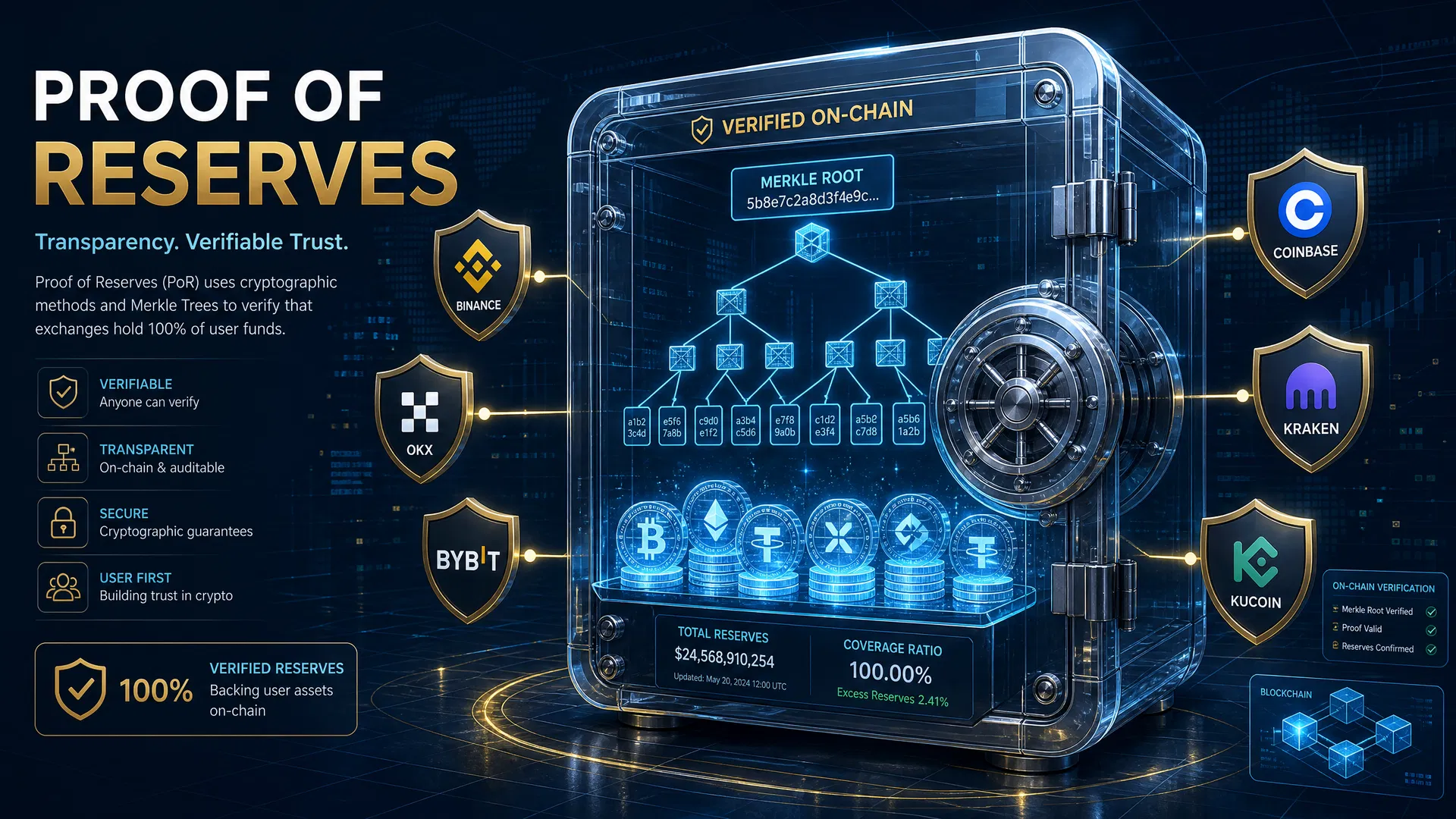
A genuine Proof of Reserves audit has three components. First, the exchange must prove ownership of its on-chain wallets by signing a cryptographic message with the private keys associated with those addresses. This demonstrates that the exchange actually controls the funds it claims to hold — not merely that it knows the addresses.
Second, the exchange must compile a complete list of customer balances — the total liabilities it owes to users. This is typically done using a Merkle tree, a data structure that allows each individual customer to verify that their balance is included in the total without revealing anyone else's data. Each customer receives a unique Merkle proof that they can independently verify.
Third, an independent auditor — typically a firm specialising in blockchain security, such as Hacken, Armanino, or Mazars — verifies that the on-chain assets exceed the total customer liabilities, and that the Merkle tree has been constructed correctly. The result is a reserve ratio: if an exchange holds 130% of customer assets, its reserve ratio is 130%.
It is important to understand what PoR does not prove. A snapshot-based PoR only reflects the exchange's position at a specific moment in time. An exchange could theoretically borrow assets to inflate its reserves before an audit and return them afterward. This is why monthly or quarterly audits by reputable third parties are significantly more meaningful than one-time snapshots. It is also why on-chain wallet verification — not just balance attestation — is the gold standard.
Exchanges With Verified Proof of Reserves in 2026
The following exchanges publish regular, verifiable Proof of Reserves data as of June 2026. Reserve ratios are the most recently published figures and are subject to change.
Binance, the world's largest exchange by volume, publishes monthly PoR reports covering BTC, ETH, USDT, USDC, and dozens of other assets. Binance's reserve ratios consistently exceed 100% across all major assets, and the exchange provides a Merkle tree verification tool that allows any user to confirm their balance is included in the published totals.
OKX publishes monthly PoR reports audited by Hacken, with reserve ratios typically between 102% and 115% across BTC, ETH, and USDT. OKX's PoR page includes a real-time wallet address explorer and a downloadable Merkle tree proof for each user.
Bybit publishes a real-time reserve dashboard showing 1:1 coverage of all user assets. The exchange uses a Merkle tree system and provides individual verification for each account. Bybit's PoR page is one of the most transparent in the industry, with wallet addresses publicly listed.
Kraken has been publishing Proof of Reserves since 2014 — longer than any other major exchange. Kraken's PoR is conducted by Armanino, a US-based accounting firm, and covers all assets held on the platform. Kraken's reserve ratios have consistently exceeded 100% across all audited assets.
MEXC launched a dedicated PoR transparency page in December 2025 following a Hacken audit. The April 2026 report shows reserve ratios of 295% for BTC, 116% for ETH, 111% for USDT, and 116% for USDC — among the highest in the industry. MEXC's total BTC reserves stand at 12,695 BTC.
Bitget publishes monthly Merkle tree PoR reports, with reserve ratios consistently above 130% across BTC, ETH, USDT, and USDC. The May 2026 report shows a total reserve ratio of 127%, with user BTC holdings of 19,644 BTC fully backed.
BingX operates a dedicated 'Balance Reserve' page showing 100% coverage of user assets. The exchange provides real-time wallet address verification and publishes reserve snapshots on a regular basis.
WhiteBIT, a European exchange headquartered in Ukraine, publishes PoR reports audited by Hacken. The most recent audit shows a collateral ratio of 238%, meaning the exchange holds more than twice the value of its customer liabilities in reserve. WhiteBIT's PoR PDF is publicly available at cdn.whitebit.com/por.pdf.
Phemex publishes monthly PoR reports with an average reserve ratio of 129.75% across BTC, ETH, USDT, and SOL as of May 2026. All reported assets remain above the 100% threshold, and Phemex provides individual Merkle tree verification for each user.
Gate.io publishes PoR data audited by Hacken, with reserve ratios consistently above 100% across all major assets. Gate.io was one of the first exchanges to adopt Merkle tree PoR following the FTX collapse.
KuCoin, Coinbase, Bitstamp, Bitfinex, HTX (formerly Huobi), Crypto.com, XT.com, BitMart, and Gemini all publish regular PoR data. Coinbase, as a publicly traded US company, is subject to SEC reporting requirements and undergoes regular financial audits in addition to its PoR disclosures.
How to Verify Your Own Balance
Most exchanges that publish Proof of Reserves provide a self-verification tool that allows you to confirm your individual balance is included in the published totals. The process typically works as follows: log into your exchange account, navigate to the PoR or Security section, and look for a 'Verify My Assets' or 'Merkle Proof' option. The exchange will provide you with a unique Merkle proof — a set of cryptographic hashes — that you can use to verify your balance against the published Merkle root.
Several independent tools exist to assist with this verification. Hacken's PoR verification portal (hacken.io) supports verification for exchanges it has audited. CoinGecko and CoinMarketCap both display PoR status and reserve ratios for exchanges in their listings, though these are aggregated from exchange-reported data rather than independently verified.
The most important thing to remember is that self-verification only tells you that your balance was included in the snapshot at the time of the audit. It does not guarantee that the exchange is solvent today. For ongoing assurance, look for exchanges that publish monthly audits by reputable third parties — not one-time snapshots.
Exchanges Without Confirmed Proof of Reserves
Not all major exchanges publish verified PoR. LBank, which ranks among the top 10 exchanges by volume, claims to have a Merkle tree PoR system, but independent security platform CER.live rates the exchange as lacking a confirmed proof-of-reserves audit. The Ontario Securities Commission issued an investor warning for LBank in August 2025. Users should exercise caution.
Several other exchanges publish reserve data without independent third-party verification. Self-reported reserves without an auditor's signature are significantly less meaningful than audited PoR — an exchange can publish any numbers it chooses without verification. When evaluating an exchange's PoR, always check whether the data was verified by a named, reputable auditing firm.
The absence of PoR is not automatically a sign of fraud — some smaller exchanges may lack the technical infrastructure or resources to implement Merkle tree verification. However, for any exchange holding significant customer assets, the failure to publish PoR in 2026 is increasingly difficult to justify. The technology is well-established, the auditing firms are readily available, and the cost of implementation is trivial compared to the trust it builds.
The Limits of Proof of Reserves
Proof of Reserves is a significant improvement over no transparency at all, but it is not a complete solution to exchange risk. The most important limitation is that PoR only measures assets, not liabilities beyond customer deposits. An exchange could hold 100% of customer assets while simultaneously carrying enormous debt obligations — loans, derivatives positions, or operational liabilities — that could threaten solvency in a market downturn.
This is why some analysts advocate for 'Proof of Solvency' — a more comprehensive disclosure that includes both assets and all liabilities. A true solvency audit would require the kind of full financial statement disclosure that publicly traded companies provide. Coinbase, as a NASDAQ-listed company, comes closest to this standard, but most exchanges remain private and are not subject to equivalent requirements.
The timing of audits also matters. A monthly snapshot can be gamed: an exchange could borrow assets before the audit date and return them afterward, temporarily inflating its reserve ratio. Real-time or near-real-time PoR — where wallet balances are continuously verifiable on-chain — is the gold standard, but few exchanges have implemented it fully.
Despite these limitations, Proof of Reserves remains the most practical tool available to retail users for assessing exchange safety. Combined with other signals — regulatory licensing, security audits, operational history, and the exchange's response to past incidents — PoR provides a meaningful data point in the overall risk assessment. In the post-FTX world, any exchange that refuses to publish PoR is asking its customers to trust it on faith alone.
What to Look for When Choosing an Exchange
When evaluating an exchange's trustworthiness, Proof of Reserves is one of several factors to consider. The most reliable exchanges combine regular PoR audits with regulatory licensing, strong security practices, and a track record of handling crises transparently.
Regulatory licensing matters because it subjects exchanges to ongoing oversight, capital requirements, and customer protection rules. Exchanges with MiCA licences in the EU, FinCEN registration in the US, or FCA authorisation in the UK are subject to regulatory scrutiny that provides an additional layer of protection beyond self-reported PoR.
Security audits — penetration testing, smart contract audits, and bug bounty programmes — indicate that an exchange takes its technical security seriously. Hacken, Trail of Bits, and Certik are among the most reputable firms conducting these audits. An exchange that publishes both PoR and security audit results is demonstrating a comprehensive commitment to transparency.
Finally, consider the exchange's history. How has it handled past security incidents? Did it compensate affected users? How quickly did it communicate? An exchange's behaviour during a crisis is often more revealing than its marketing materials. ExchangeRank's Safety Score incorporates all of these factors — PoR status, regulatory licensing, MiCA compliance, and historical incidents — into a single composite metric for each exchange.
Related Articles

Which Crypto Exchanges Are MiCA-Compliant in 2026?
June 11, 2026 · 12 min read
How ExchangeRank Collects and Processes Exchange Data — Our Independent Infrastructure
June 8, 2026 · 7 min read

MEXC Faces U.S. Financial Cutoff Over $16 Billion Allegations—But the Order Is Not Immediate
November 9, 2026 · 5 min read

Binance Restarts Withdrawals After $6.3 Billion Hack—95% Replaced, Not Recovered
November 1, 2026 · 5 min read