How Decentralized Exchanges Captured 24% of the Perpetuals Market in 2026
Decentralized perpetual exchanges have tripled their share of the global derivatives market in a single year, rising from 6.4% to 24.3% of all perpetual futures volume. Hyperliquid alone processed $633 billion in Q1 2026, making it the third-largest perp venue in the world — behind only Binance and OKX. This is the data behind the most consequential structural shift in crypto trading since the DeFi summer of 2020.

Two years ago, the idea that a decentralized exchange could compete with Binance on perpetual futures volume was dismissed as wishful thinking. Today it is a documented fact. According to CoinGecko's 2026 CEX & DEX Trading Activity Report, the DEX-to-CEX share of the perpetual futures market has more than tripled in a single year — rising from 6.42% in early 2025 to 24.3% by the end of the year — driven by an eight-fold increase in absolute on-chain perp volume, from $81.74 billion in January 2024 to $739.48 billion in January 2026. The migration from centralized to on-chain derivatives trading is no longer a prediction; it is the most consequential structural shift in crypto markets since the DeFi summer of 2020.
At the center of this shift sits Hyperliquid, a purpose-built Layer-1 blockchain that has become the dominant venue for on-chain perpetual futures. The platform processed $633 billion in total trading volume in Q1 2026 alone — a more than six-fold increase from Q2 2024 — and commands approximately 32% of all on-chain perpetual futures volume, according to VanEck research published in May 2026. With over 274,000 monthly active traders and $8.97 billion in open interest, Hyperliquid has achieved a scale that would have seemed impossible for a decentralized venue just two years ago. Its 30-day volume of $181.7 billion in April 2026, with daily volume regularly exceeding $8 billion, places it in a category of its own among decentralized platforms.
The architectural decision that separates Hyperliquid from earlier DEX attempts is its own Layer-1 chain, built from scratch for trading performance rather than deployed on top of Ethereum or Solana. This means Hyperliquid does not compete for block space with unrelated applications, does not pay gas fees to a separate network, and can optimize every component of its infrastructure — from the matching engine to the liquidation system — for trading latency and throughput. The result is an order-book exchange that settles every trade on a public ledger while delivering execution quality that professional traders, not just DeFi natives, are willing to use. Institutions including Ripple Prime, Komainu, and Paradigm have all been identified as active participants on the platform.
The single most powerful driver pushing traders toward self-custodied venues is the accumulated record of centralized custody failures, and 2025 supplied the most expensive data point in the industry's history. On February 21, 2025, attackers attributed by the FBI to North Korea's Lazarus Group drained approximately $1.5 billion in Ethereum from Bybit's cold-wallet infrastructure — the largest crypto theft ever recorded. Chainalysis data shows this single incident accounted for roughly 44% of the more than $3.4 billion stolen across the entire year, and that centralized services, not DeFi protocols, were the primary targets. For a growing number of traders, the conclusion is straightforward: funds on an exchange's balance sheet represent a single point of failure that self-custody removes entirely.
Hyperliquid has also opened markets that centralized exchanges structurally cannot offer. Through its HIP-3 permissionless perpetuals framework, launched in October 2025, the platform now lists 24/7 perpetuals on real-world assets including oil, gold, and equity indices — instruments that traditional commodity and equity exchanges restrict to fixed trading sessions. Open interest in RWA perpetuals reached $2.65 billion by late March 2026, doubling in just two months, according to CryptoBriefing. This is not a feature that centralized crypto exchanges can replicate without licensing arrangements that would take years to obtain, which means a growing subset of trading activity now happens on-chain not by preference but by structural necessity.
The DEX perp boom has not been a straight line, and honest analysis requires acknowledging the limits of the trend. DeFiLlama data showed 30-day perp DEX volume declining for five consecutive months after the October 2025 peak, falling to $628.99 billion by early April 2026, as the broader market cooled. Centralized exchanges still process the overwhelming majority of derivatives volume — Binance alone recorded $25 trillion in derivatives volume in 2025, according to VanEck — and the top three CEXs collectively maintain a market share that no single on-chain venue approaches. The migration on-chain is a secular trend, but it breathes with the market cycle like everything else in crypto, and the retention of on-chain venues through a deep, prolonged downturn remains an open empirical question.
The competitive response from centralized exchanges is already underway. Several major CEXs have launched or announced hybrid custody models, embedded DeFi yield products, and on-chain settlement options that attempt to combine the liquidity depth of a centralized book with the transparency of public ledger settlement. Binance's move into tokenized real-world asset derivatives — SpaceX perpetual futures became its second-largest traded product in June 2026, capturing over 60% market share across CEX and DEX venues — shows that incumbents intend to compete on the migration's own terms. The most accurate characterization of 2026 is therefore not that traders are abandoning centralized exchanges, but that the default is dissolving: sophisticated traders now allocate across both centralized and on-chain venues based on the specific trade, the required custody model, and the available liquidity, rather than choosing one category exclusively.
For traders evaluating where to execute in mid-2026, the data supports a nuanced conclusion. On-chain perpetual venues now offer genuine institutional-grade liquidity for major pairs, verifiable settlement, and access to markets that do not exist elsewhere — but they also require full self-custody responsibility, carry smart-contract risk, and lack the fiat on-ramps and customer support infrastructure that centralized exchanges provide. The 24% DEX share of perp volume is a milestone, not a ceiling, and the structural forces driving it — custody risk awareness, demand for verifiable settlement, and the expansion of permissionless markets — show no sign of reversing. Whether the next 24 months see DEX perp share reach 40% or plateau at current levels will depend on whether on-chain venues can retain their user base through the next market downturn, and whether centralized exchanges can successfully absorb the migration through hybrid product offerings.
Related Articles

Solana DEXs Outrank Bybit, Coinbase, and Kraken in Spot Volume — Four Weeks Running
August 3, 2026 · 7 min read
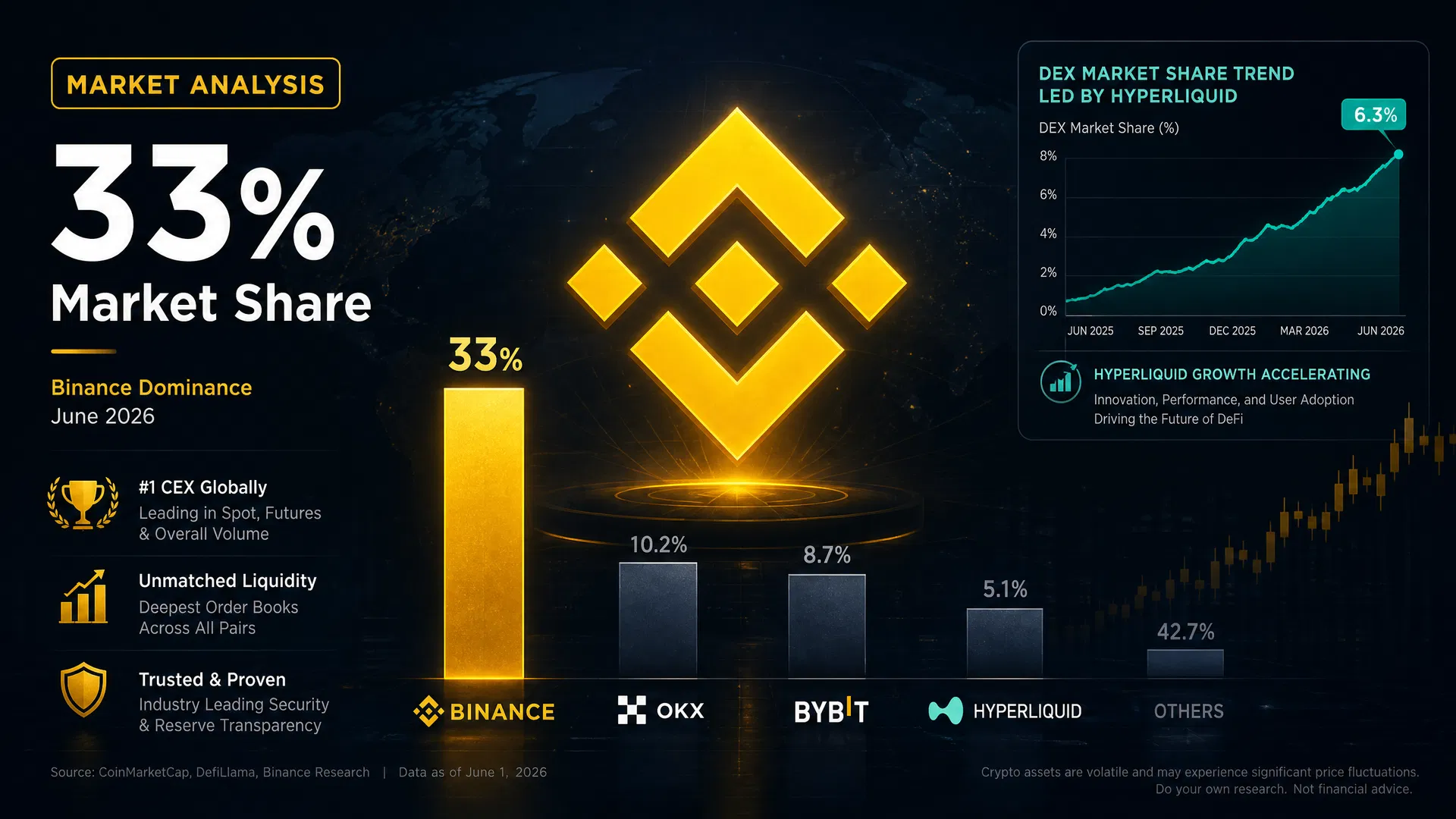
Binance Maintains Dominance in June 2026 — But DEX Volume Surges 34%
June 10, 2026 · 7 min read
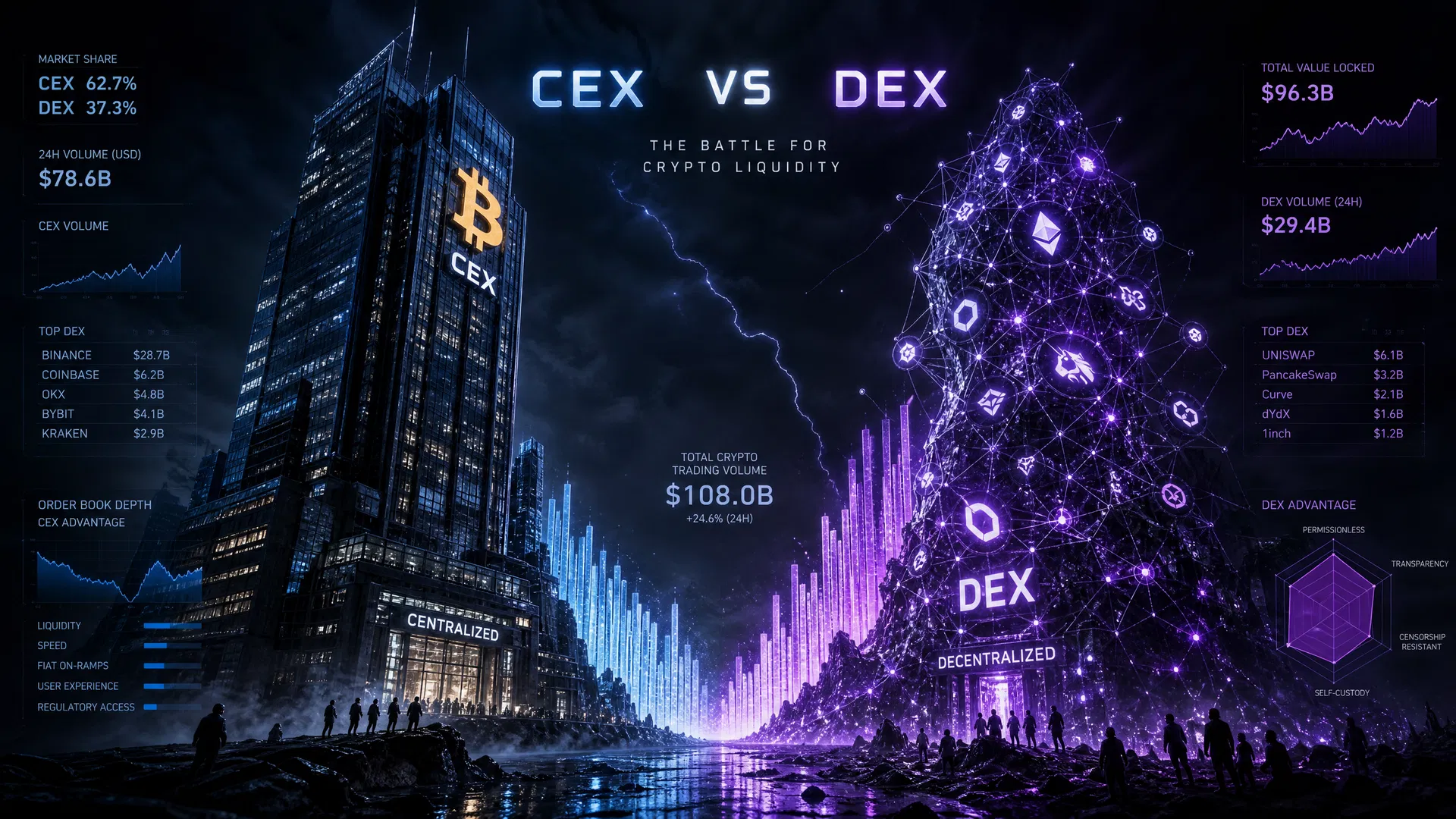
DEX vs CEX: The Volume Gap Is Closing — What the Data Shows
May 15, 2026 · 6 min read

Crypto Exchange Volume Doubles in Five Days — But ETFs and DEXs Are Rewriting the Market
August 31, 2026 · 6 min read