Legal Crypto Exchanges in the USA (2026): Which Platforms Are Regulated and Most Popular?
After years of regulatory uncertainty, the US crypto market has entered a new era. We break down which exchanges are fully licensed, what regulations they must follow, and which platforms dominate American trading in 2026.
The New Era of US Crypto Regulation
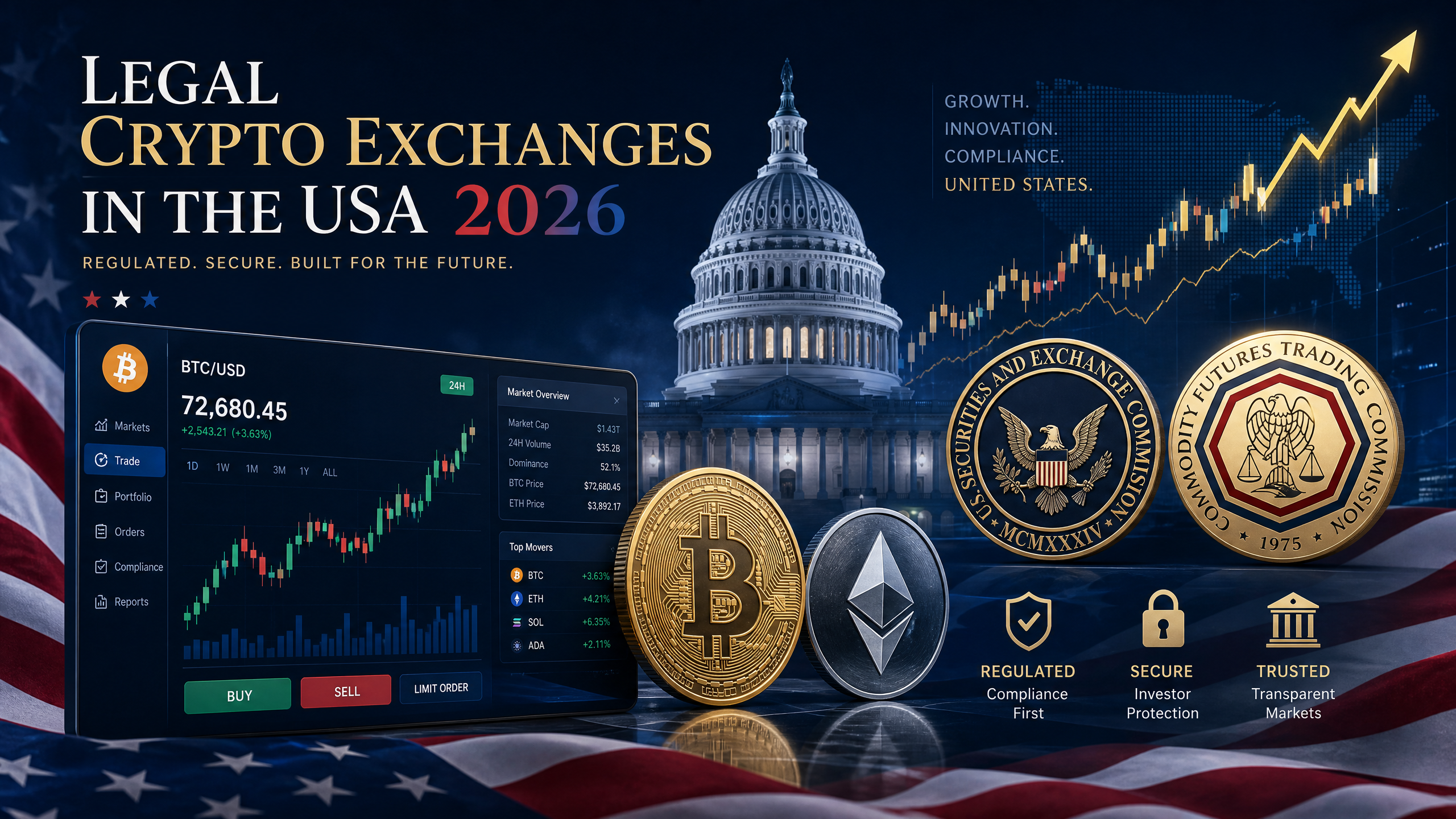
For years, the United States crypto market was defined by regulatory ambiguity. Exchanges operated in a grey zone, agencies competed for jurisdiction, and enforcement actions came without warning. That era is ending. In 2025 and 2026, a series of landmark developments — the GENIUS Act for stablecoins, the FIT21 framework for digital commodities, and a dramatic shift in SEC enforcement posture — have created the most structured regulatory environment the US crypto market has ever seen.
As of June 2026, operating a crypto exchange in the United States requires compliance with a layered system of federal and state rules. At the federal level, every exchange must register with FinCEN as a Money Services Business (MSB) and implement AML/KYC programs under the Bank Secrecy Act. At the state level, exchanges must hold Money Transmitter Licenses (MTLs) in each state where they operate — and in New York, the notoriously strict BitLicense issued by NYDFS. California's Digital Financial Assets Law (DFAL) took effect on July 1, 2026, adding another layer of compliance for the nation's most populous state.
The result: only a handful of exchanges have the resources and compliance infrastructure to operate fully legally across all 50 states. This guide covers who they are, what makes them compliant, and which platforms American traders actually use.
How US Crypto Regulation Works: The Key Agencies
Understanding which exchanges are legal requires understanding who regulates them. The US has no single crypto regulator — instead, oversight is split across multiple federal and state agencies, each with distinct jurisdiction.
The Securities and Exchange Commission (SEC) oversees digital assets that qualify as securities. Under Chair Paul Atkins (appointed 2025), the SEC has shifted from aggressive enforcement to a more collaborative approach, publishing clearer guidance on which tokens are securities and creating a dedicated crypto task force. Exchanges listing tokens classified as securities must register as broker-dealers or alternative trading systems (ATS).
The Commodity Futures Trading Commission (CFTC) regulates Bitcoin, Ethereum, and other assets classified as commodities, as well as crypto derivatives. The Financial Crimes Enforcement Network (FinCEN) requires all crypto exchanges to register as Money Services Businesses, implement AML programs, file Suspicious Activity Reports (SARs), and conduct KYC verification on all customers. At the state level, New York's NYDFS issues the BitLicense — the most comprehensive and demanding state crypto license in the country. California's DFPI now enforces the Digital Financial Assets Law (DFAL). All other states require standard Money Transmitter Licenses through their respective banking departments.
Fully Licensed US Crypto Exchanges (2026)
Coinbase is the gold standard of US crypto compliance. Founded in 2012 and publicly listed on NASDAQ (COIN) since 2021, Coinbase holds the New York BitLicense, MTLs in all 50 states, and is registered with FinCEN. It operates Coinbase Advanced Trade for experienced traders and Coinbase Prime for institutional clients. As of June 2026, Coinbase has approximately 108 million verified users and $330 billion in assets on platform. Its 24h trading volume typically ranges from $1.5B to $3B.
Kraken is the second-largest US-based exchange by volume and reputation. Founded in 2011 in San Francisco, Kraken holds the BitLicense, MTLs across the US, and FinCEN MSB registration. Kraken is known for its strong security record (no major hacks in 14 years of operation), deep liquidity, and support for margin trading and futures through Kraken Pro. In 2025, Kraken acquired NinjaTrader, expanding into traditional futures markets.
Gemini, founded by the Winklevoss twins in 2014, was one of the first exchanges to obtain the New York BitLicense (2015). Gemini is regulated by NYDFS as a trust company — a higher standard than a standard BitLicense — and holds MTLs across the US. Gemini is known for its institutional-grade custody (Gemini Custody) and its GUSD stablecoin, which is regulated under New York trust law.
Robinhood Crypto operates under Robinhood's existing broker-dealer infrastructure and FinCEN MSB registration. Available in all 50 states, Robinhood offers commission-free crypto trading alongside stocks and ETFs. Bitstamp USA holds the New York BitLicense and MTLs across the US, and is particularly popular among institutional traders and OTC desks. eToro USA holds FinCEN MSB registration and state MTLs, offering social trading (copy trading) features and approximately 80 cryptocurrencies.
Comparison Table: Top Legal US Exchanges
The table below compares the key metrics of the most popular legal crypto exchanges available to US users as of June 2026. Fees shown are for standard spot trading. Volume data as of June 2026.
| Exchange | Founded | Licenses | Coins | Maker Fee | Taker Fee | 24h Volume | Best For |
|---|---|---|---|---|---|---|---|
| Coinbase | 2012 | BitLicense, MTL 50 states, FinCEN | 240+ | 0.00% | 0.05% | $1.5–3B | Beginners, institutional |
| Kraken | 2011 | BitLicense, MTL, FinCEN | 250+ | 0.16% | 0.26% | $1.8–2.5B | Security-focused, advanced |
| Gemini | 2014 | NYDFS Trust, MTL, FinCEN | 70+ | 0.00% | 0.40% | $0.3–0.5B | Institutional, custody |
| Robinhood | 2018 | MTL, FinCEN, FINRA | 20+ | 0.00% | 0.00% | $0.5–1B | Beginners, commission-free |
| eToro USA | 2018 | MTL, FinCEN | 80+ | 1.00% | 1.00% | $0.1–0.3B | Social/copy trading |
| Bitstamp USA | 2011 | BitLicense, MTL, FinCEN | 85+ | 0.30% | 0.40% | $0.3–0.5B | OTC, institutional |
Fees shown are for standard spot trading. Volume data as of June 2026.
The Most Popular Exchanges Among American Traders
Regulatory compliance and popularity do not always overlap. Surveys of US crypto traders consistently show that Coinbase and Robinhood dominate in terms of user count, while Kraken leads among experienced and security-conscious traders.
Coinbase remains the most downloaded crypto app in the US App Store and Google Play. Its integration with traditional finance (Coinbase Card, direct bank transfers, PayPal integration) and its status as a publicly listed company give it unmatched mainstream credibility. The launch of Base, Coinbase's Ethereum Layer 2 network, has also made it a hub for DeFi activity among US users.
Robinhood has the second-largest US crypto user base, driven by its zero-commission model and the fact that millions of Americans already use it for stock trading. However, Robinhood's crypto offering is limited — users cannot withdraw crypto to external wallets on the basic plan, and the coin selection is small compared to Coinbase or Kraken.
Kraken consistently ranks highest in security audits and is the preferred exchange for US users who prioritize self-custody, advanced order types, and staking. Gemini has carved out a niche as the institutional and custody-focused exchange, widely used by family offices and hedge funds. Beyond these four, a significant portion of US traders also use Crypto.com (which holds MTLs and FinCEN registration) and OKX (which relaunched its US operations in 2025 with full MTL compliance after settling with DOJ in 2024).
Exchanges Restricted or Unavailable in the USA
Not all major global exchanges are available to US users. Several of the world's largest platforms by volume are either restricted from serving US customers or operate in a legal grey zone.
Binance.com — the world's largest exchange by volume — is not available to US residents. Binance.US, its American subsidiary, settled with the DOJ and FinCEN in November 2023 for $4.3 billion and has operated under a compliance monitor since. As of 2026, Binance.US has significantly reduced its coin offerings and trading volume compared to its 2021–2022 peak.
KuCoin settled with the DOJ in 2024 for $300 million and has since relaunched with US compliance infrastructure. Bybit withdrew from the US market in 2023 but has been exploring a re-entry under the new regulatory framework. BitMEX, once the dominant derivatives platform, remains unavailable to US users following its 2020 CFTC and DOJ settlements. The general rule: if an exchange is not listed on the FinCEN MSB registry and does not hold state MTLs, it is not legally operating in the US.
What the GENIUS Act and FIT21 Mean for US Traders
Two landmark pieces of legislation passed in 2025 are reshaping the US crypto landscape for traders and exchanges alike.
The GENIUS Act (Guiding and Establishing National Innovation for US Stablecoins Act), signed into law in July 2025, created the first federal framework for stablecoins. Under GENIUS, stablecoin issuers must maintain 1:1 reserves in cash or short-term Treasuries, publish monthly attestations, and obtain approval from either a federal banking regulator or a state regulator. This has significant implications for exchanges: USDT (Tether) does not comply with GENIUS requirements and is being phased out on US-licensed exchanges, replaced by USDC (Circle) and PYUSD (PayPal).
The FIT21 Act (Financial Innovation and Technology for the 21st Century Act) clarified the SEC/CFTC jurisdictional split. Bitcoin and Ethereum are definitively classified as commodities under CFTC jurisdiction. Tokens that are "sufficiently decentralized" fall under CFTC; tokens with active development teams and investor expectations of profit remain under SEC jurisdiction as securities. For traders, the practical impact is: more coins available on US exchanges, clearer tax treatment, and a more stable regulatory environment — but also stricter KYC requirements and the gradual disappearance of USDT from US platforms.
How to Verify if an Exchange is Legal in the USA
Before depositing funds on any crypto exchange, US users can take several steps to verify its regulatory status.
First, check the FinCEN MSB Registry — the Financial Crimes Enforcement Network maintains a public registry of all registered Money Services Businesses at fincen.gov. Search for the exchange by name to confirm federal registration. Second, check the NYDFS BitLicense List — the New York Department of Financial Services publishes a list of all BitLicense holders at dfs.ny.gov. If an exchange claims to serve New York residents, it must appear on this list.
Third, use the NMLS Consumer Access portal at nmlsconsumeraccess.org to search for licensed money transmitters across multiple states. Fourth, for exchanges offering derivatives or tokens classified as securities, check the SEC's EDGAR database and the CFTC's registration database. Finally, reputable exchanges clearly disclose their regulatory status, licenses, and the states where they are available in their Terms of Service and legal disclosure pages.
Useful Resources
FinCEN MSB Registry
https://www.fincen.gov/msb-registrant-search
NYDFS BitLicense Holders
https://www.dfs.ny.gov/apps_and_licensing/virtual_currency_businesses/approved_vc_entities
NMLS Consumer Access
https://www.nmlsconsumeraccess.org/
Related Articles

Solana DEXs Outrank Bybit, Coinbase, and Kraken in Spot Volume — Four Weeks Running
August 3, 2026 · 7 min read

Binance on the Brink: Last Days to Secure MiCA Licence — What an EU Ban Would Mean for the World's Largest Exchange
June 21, 2026 · 9 min read
USDT Effectively Banned in Europe: Binance, Coinbase and Kraken Restrict Tether Ahead of MiCA Deadline
June 20, 2026 · 6 min read

SEC Moves to Allow Crypto Exchanges to Trade Tokenized Stocks — A Historic Market Shakeup Begins
June 18, 2026 · 6 min read