Stablecoin Market H1 2026: USDC Captures 70% of Volume as Banks Abandon the Sidelines
Record $1.79 trillion in June 2026 stablecoin volume marks a structural shift: USDC now commands 70% of adjusted transaction volume while Tether's USDT holds 25%, as BNY, Standard Chartered, and the GENIUS Act reshape the competitive landscape.
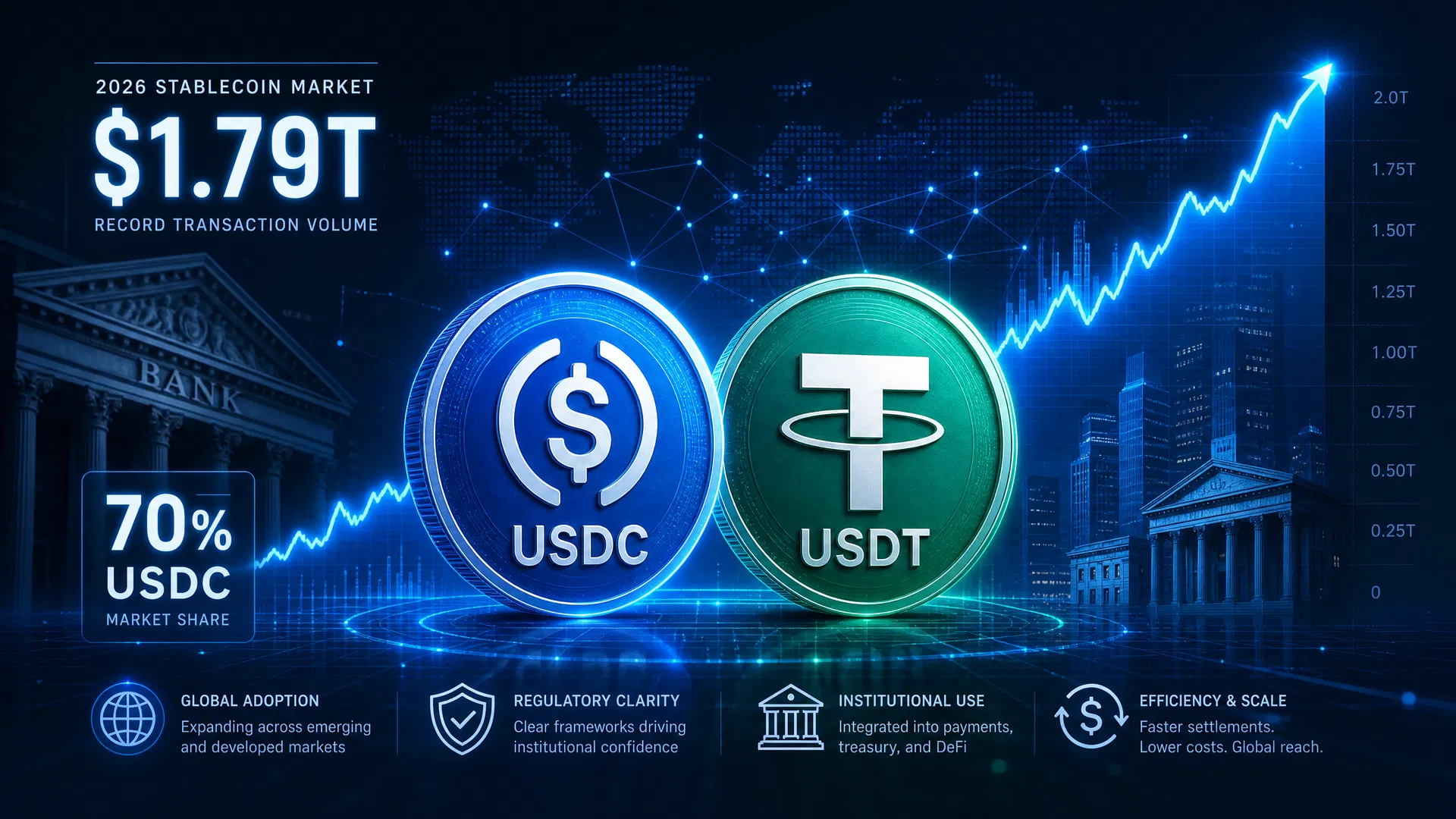
The first half of 2026 will be remembered as the period when stablecoins graduated from a crypto-trading convenience into a pillar of global financial infrastructure. Adjusted stablecoin transaction volume reached a record $1.79 trillion in June alone — a 63% surge from May's $1.1 trillion and a 125% increase year-over-year — according to data from Visa's Allium-powered on-chain analytics dashboard. For the full six months, the total reached $8.82 trillion, already surpassing the entire 2024 annual figure of $5.8 trillion and putting the market on pace to approach 2025's record $10.8 trillion.
Beneath the headline numbers, a structural realignment is underway. Circle's USDC accounted for approximately 70% of adjusted stablecoin transaction volume across H1 2026, with its share reaching 67% — roughly $1.21 trillion — in June alone. Tether's USDT, long the dominant force in the market, held only around 25% of H1 volume. The reversal is striking when viewed in historical context: in 2020, USDT commanded nearly 90% of adjusted transaction volume while USDC accounted for less than 10%. By 2022, USDC had climbed to roughly 45%. The shift reflects a fundamental change in who is using stablecoins and for what purpose.
Regulatory Clarity Drives USDC's Ascent
The primary driver of USDC's ascent is regulatory clarity. Circle, as a US-domiciled company that has consistently prioritised compliance, has emerged as the principal beneficiary of the United States' multi-year effort to establish a coherent stablecoin framework. The GENIUS Act — signed into law by President Trump on July 18, 2025 — establishes who can issue stablecoins, what reserves they must hold, and how those reserves must be audited. The law goes into effect on January 18, 2027, and FinCEN proposed implementation rules in June 2026.
When banks, payment processors, and corporate treasuries need to move dollar-denominated value on-chain, they are increasingly choosing the token that carries the clearest regulatory seal of approval. USDC turned over its entire circulating supply of approximately $73.7 billion roughly 16 times in a single month — a velocity characteristic of a payments and settlement instrument rather than a speculative store of value.
Wall Street's Biggest Banks Join the Network
The institutional endorsement of USDC became concrete in late June and early July 2026. BNY — the world's largest custody bank, with $59 trillion in assets under management and one of only eight global systemically important banks — expanded its USDC services to allow institutional clients to custody, mint, and redeem the stablecoin using its own infrastructure rather than building their own. Days later, Standard Chartered announced it would offer institutional clients direct access to USDC minting and redemption through a partnership with Circle.
Both decisions signal that the debate inside global banking has shifted. The question is no longer whether stablecoins belong in finance, but how banks fit into the networks forming around them. As Andrew MacKenzie, founder and CEO of Scotland-based stablecoin issuer Agant, put it: 'Banks aren't asking whether they'll use stablecoins anymore. They're deciding how they'll use them.' Industry executives note that the real value lies not in the token itself but in the network of liquidity, banking relationships, and integrations surrounding it — a dynamic that heavily favours incumbents with established ecosystems.
Market Cap Pullback: Context Over Panic
Despite the record transaction volumes, the stablecoin market's aggregate supply has contracted. Total stablecoin market capitalisation peaked at roughly $315 billion in May 2026 before declining by approximately $10 billion through early July — the largest dollar-amount pullback since the Terra-Luna collapse of May 2022. USDT fell from $190 billion to around $184 billion, while USDC retreated from a March peak of nearly $80 billion to approximately $73 billion.
On a percentage basis, however, the decline amounts to only about 3% — a modest correction compared with the 26% contraction during the 2022 bear market. Analysts note that similar pullbacks occurred in late 2025 and early 2026 before supply rebounded to new records. Notably, USDT's market capitalisation briefly overtook Ethereum's on June 26, 2026, reaching $186 billion versus Ethereum's $185.66 billion — a symbolic milestone reflecting the stablecoin's extraordinary growth over the past two years. 'The recent decline in stablecoin market cap represents a relatively small pullback in what we believe is a long-term growth market,' said Paul Howard, senior director at trading firm Wincent.
New Entrants Challenge the Duopoly
The regulatory tailwind is attracting well-capitalised new competitors. OpenUSD, backed by a consortium that includes Coinbase, Stripe, and BlackRock, launched in late June 2026 as a direct rival to USDC, prompting Circle's CEO Jeremy Allaire to defend USDC's position on the basis of nearly a decade of accumulated liquidity, banking relationships, and regulatory approvals. Paxos's Global Dollar (USDG), backed by a consortium that includes Robinhood, surpassed $3.2 billion in circulation. USDGO, issued by Anchorage Digital with Hong Kong's OSL Group, nearly doubled to $900 million.
The arrival of these challengers suggests the stablecoin market is entering a more competitive phase. However, network effects continue to favour incumbents: the value of a stablecoin is determined not by the token itself but by the breadth of its integrations, the depth of its liquidity, and the trust of the institutions that have built infrastructure around it. As Steakhouse Financial's Adrian Cachinero Vasiljevic observed: 'Anybody can issue a stablecoin. But if nobody uses the stablecoin, the stablecoin is worthless. The value of the stablecoin is the network.'
Europe Pushes Back with Euro Stablecoins
European financial institutions are responding to the dollar stablecoin wave with their own initiatives. Dollar-pegged tokens currently account for more than 99% of total stablecoin market capitalisation, a concentration that has alarmed European regulators and banks. Qivalis, a consortium of 37 European financial institutions, is developing Euro On-Chain (EUOC) as a shared infrastructure project, arguing that collective network effects are essential for a euro stablecoin to achieve meaningful liquidity.
Societe Generale has its EUR CoinVertible (EURCV), and Credit Agricole launched EURXT in July 2026. Jan-Oliver Sell, CEO of Qivalis, has articulated the stakes plainly: 'If we don't have a euro on the blockchain, the banks will use the dollar because it's there, it's available and it has a lot of liquidity.' Europe already has regulatory oversight under the Markets in Crypto-Assets (MiCA) framework; what it lacks is sufficient euro-denominated liquidity to prevent settlement activity from migrating to dollar-backed stablecoins.
The Road to 2030: Quadrillion-Dollar Projections
The long-term projections for the stablecoin market are ambitious. Citi revised its 2030 forecast to $1.9 trillion in its base case and $4 trillion in a bull case. Standard Chartered projects a $2 trillion market by 2028. Chainalysis has gone further, estimating that stablecoin settlement volumes could reach one quadrillion dollars annually by 2030 — a figure that would place stablecoins at the centre of global payments infrastructure.
Whether those projections prove accurate will depend on regulatory implementation, competitive dynamics, and the willingness of traditional financial institutions to integrate digital settlement rails at scale. What the first half of 2026 has demonstrated, however, is that the structural shift is already well underway. The $8.82 trillion in H1 2026 adjusted volume — more than the entirety of 2024 — is not a speculative projection. It is a data point that the financial industry can no longer afford to ignore.
Related Articles
GENIUS Act Explained: What the First US Stablecoin Law Means for Crypto Traders in 2026
June 12, 2026 · 9 min read

Crypto Hacks H1 2026: $972 Million Stolen in 207 Attacks — Lazarus Group Dominates
July 6, 2026 · 8

BitMEX Is Closing: The Exchange That Invented Perpetual Futures Shuts Down After 11 Years
August 10, 2026 · 7 min read

Crypto Exchanges Are Becoming Stock Markets: RWA Perpetuals Hit $311B Record in June 2026
July 20, 2026 · 7 min read