The $60 Billion Collapse: How TerraLUNA Destroyed Itself in 72 Hours
In May 2022, the Terra ecosystem — once the second-largest DeFi platform in the world — imploded in less than a week. $60 billion in value evaporated, a contagion swept through the crypto industry, and its founder Do Kwon became a fugitive. This is the definitive account of how it happened.
How the Peg Was Supposed to Work
In the world of cryptocurrency, few projects generated as much excitement — or as much controversy — as the Terra ecosystem built by Do Kwon and Terraform Labs. At its peak in April 2022, the Terra blockchain was the second-largest DeFi ecosystem in the world, with over $60 billion in total value locked. Its native token LUNA traded above $119, and its algorithmic stablecoin TerraUSD (UST) had become the third-largest stablecoin by market cap, with $18.7 billion in circulation.
The promise was revolutionary: a stablecoin that maintained its $1 peg not through collateral held in a bank vault, but through a sophisticated algorithmic mechanism. No dollars in reserve, no custodian risk, no regulatory chokepoints. Pure code. Pure math. Or so the theory went.
How the Peg Was Supposed to Work
The UST/LUNA system relied on a mint-and-burn arbitrage mechanism. To mint $1 of UST, you had to burn $1 worth of LUNA. To redeem $1 of UST, you received $1 worth of LUNA. This created a natural incentive: if UST fell below $1, arbitrageurs could buy cheap UST, burn it for $1 of LUNA, and pocket the difference — in theory pushing UST back to $1.
The Attack Begins: May 7–8, 2022
The Anchor Protocol amplified this dynamic dramatically. Anchor offered UST depositors a near-guaranteed 19.5% annual yield — a rate that was essentially subsidized by Terraform Labs from its treasury. At its peak, Anchor held over $14 billion in UST deposits. Critics had long warned that this yield was unsustainable, that it was essentially a Ponzi structure requiring constant new capital inflows to fund existing depositors. Do Kwon dismissed these concerns publicly and often mockingly.
The Attack Begins: May 7–8, 2022
The sequence of events that destroyed Terra began on the weekend of May 7–8, 2022. A large entity — later suspected by some analysts to be a coordinated short attack, though this was never conclusively proven — began withdrawing massive amounts of UST from the Anchor Protocol and simultaneously selling large quantities of UST on the Curve Finance liquidity pool, which was the primary venue for large-scale UST/stablecoin swaps.
Within hours, the Curve pool became severely imbalanced. UST began trading at $0.985 — a small deviation, but enough to trigger alarm. The Luna Foundation Guard (LFG), a non-profit established by Terraform Labs to defend the peg, began deploying its Bitcoin reserves. The LFG had accumulated approximately $3.5 billion in Bitcoin specifically for this purpose. It began selling BTC to buy UST and stabilize the peg.
The Death Spiral: May 9–12, 2022
The Death Spiral: May 9–12, 2022
What followed was a textbook bank run, accelerated by the reflexive nature of the LUNA/UST mechanism. As UST lost its peg further, users rushed to redeem UST for LUNA. But each redemption minted new LUNA, increasing the circulating supply and diluting the price. A falling LUNA price meant each dollar of UST required more and more LUNA to redeem — hyperinflation of the token supply in real time.
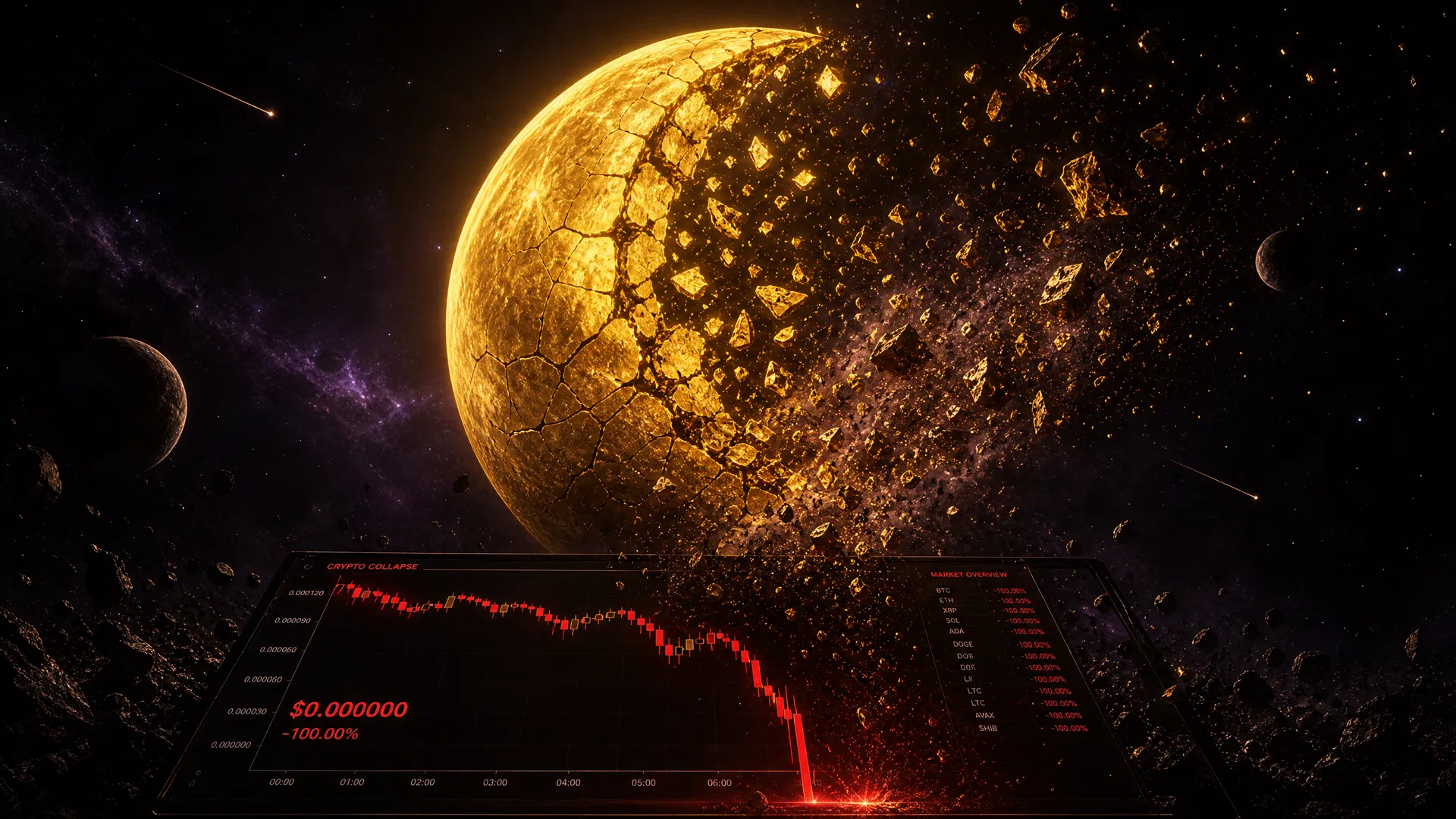
The numbers were staggering. LUNA's circulating supply went from approximately 350 million tokens to over 6.5 trillion tokens in less than a week. The price collapsed from $80 to fractions of a cent. UST, which had been designed to always be worth $1, fell to $0.10, then $0.05, then effectively zero.
By May 12, the Terra blockchain itself had to be halted twice to prevent governance attacks — a situation where the collapsed LUNA price made it trivially cheap to acquire enough tokens to control the network. The Luna Foundation Guard's Bitcoin reserves were entirely depleted. All $3.5 billion in BTC had been sold, and the peg was not saved.
The Human Cost
The Human Cost
The collapse wiped out an estimated $60 billion in market value in less than two weeks. But the raw numbers obscure the human dimension. Retail investors in South Korea — where Terraform Labs was headquartered and where crypto adoption was particularly high — had concentrated significant portions of their savings in LUNA and UST, attracted by Anchor's 19.5% yield. Reports emerged of suicides, bankruptcies, and life savings obliterated overnight.
The contagion spread rapidly through the crypto ecosystem. Three Arrows Capital (3AC), one of the largest crypto hedge funds, had made enormous leveraged bets on LUNA and was destroyed. Its collapse triggered a cascade of failures: Celsius Network, Voyager Digital, and BlockFi all had significant exposure to 3AC and subsequently filed for bankruptcy. The Terra collapse was not an isolated event — it was the first domino in a chain reaction that defined the 2022 crypto winter.
Do Kwon: From "Lunatic" to Fugitive
Do Kwon: From "Lunatic" to Fugitive
In the immediate aftermath, Do Kwon attempted to revive the Terra ecosystem by launching a new blockchain — Terra 2.0 — and distributing a new LUNA token to affected holders. The market received this with deep skepticism. The new LUNA token collapsed almost immediately after launch.
In September 2022, South Korean authorities issued an arrest warrant for Do Kwon on charges of fraud and violation of capital markets law. Interpol issued a red notice. Do Kwon, who had initially denied being a fugitive while apparently traveling internationally, was arrested in Montenegro in March 2023 while attempting to board a flight using falsified Costa Rican documents.
After a lengthy extradition battle between South Korea and the United States — both seeking to prosecute him — Do Kwon was extradited to the United States in December 2024. In April 2025, he pleaded guilty to fraud charges in a New York federal court, admitting to deceiving investors about the stability of the UST peg and the health of the Anchor Protocol. He faces up to 20 years in prison.
Regulatory Aftermath and the MiCA Connection
Regulatory Aftermath and the MiCA Connection
The Terra collapse had profound regulatory consequences. In the United States, the SEC used the Terra case as a centerpiece of its argument that algorithmic stablecoins are unregistered securities. In the European Union, the collapse directly accelerated the implementation of the MiCA (Markets in Crypto-Assets) regulation, which includes specific provisions for stablecoin issuers — requiring them to hold adequate liquid reserves and limiting the daily transaction volume of non-euro stablecoins.
Under MiCA rules, TerraUSD as it existed would have been illegal in the EU: an algorithmic stablecoin with no backing reserves, offering unsustainable yields through an affiliated protocol. The regulation explicitly prohibits algorithmic stablecoins that rely solely on token-burning mechanisms to maintain their peg.
Lessons for the Industry
The Terra collapse exposed several fundamental vulnerabilities in the DeFi ecosystem. First, the danger of reflexivity: systems where falling prices trigger mechanisms that cause further price falls are inherently unstable under stress. Second, the danger of unsustainable yields: Anchor's 19.5% APY was not a product of genuine economic activity but of subsidies that would eventually run out. Third, the danger of concentrated risk: the entire Terra ecosystem — LUNA, UST, Anchor — was deeply interconnected, meaning a failure in one component could cascade through all others simultaneously.
Lessons for the Industry
Perhaps most importantly, the Terra collapse demonstrated that 'algorithmic' does not mean 'trustless.' The system required constant human intervention — the Luna Foundation Guard's Bitcoin purchases, Terraform Labs' treasury subsidies, Do Kwon's public confidence campaigns — to function. When confidence evaporated, no algorithm could restore it.
Related Articles

MEXC Faces U.S. Financial Cutoff Over $16 Billion Allegations—But the Order Is Not Immediate
November 9, 2026 · 5 min read

HTX’s UK Exit Gains Court Backing as FCA Secures Pledge Through 2031
November 2, 2026 · 5 min read

Binance Restarts Withdrawals After $6.3 Billion Hack—95% Replaced, Not Recovered
November 1, 2026 · 5 min read

CFTC Outlines Federal Route for Leveraged Crypto Exchanges—But Final Rules Are Still Ahead
October 12, 2026 · 5 min read