Is USD Coin (USDC) the Safer Stablecoin?
USDC is the world's most regulated stablecoin — monthly attestations, BlackRock-managed reserves, GENIUS Act compliant, NYSE listed. But when SVB collapsed in March 2023, USDC dropped to $0.87 while Tether held its peg. So which stablecoin is actually safer — and what does 'safe' even mean in crypto?
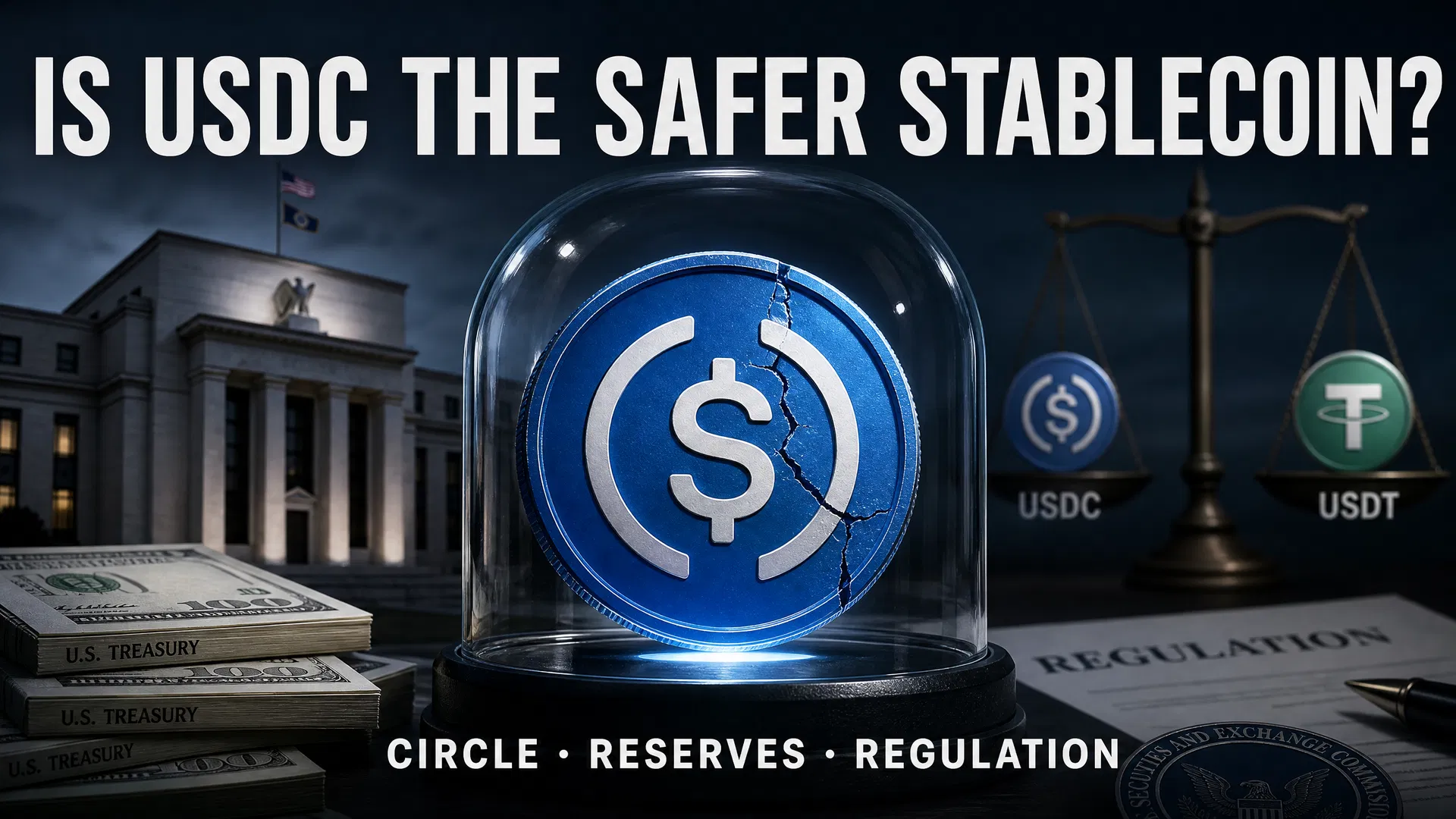
In the world of stablecoins, USD Coin (USDC) has long been positioned as the responsible alternative to Tether. While Tether has faced regulatory fines, accusations of reserve misrepresentation, and a decade of opacity, Circle — the company behind USDC — has pursued a different strategy: transparency, regulatory compliance, and institutional credibility. With a market capitalization exceeding $60 billion as of early 2026, USDC is the world's second-largest stablecoin and, by many measures, the most regulated digital dollar in existence.
But 'safer' is a relative term in crypto. The March 2023 Silicon Valley Bank crisis exposed a vulnerability that many had overlooked: USDC's very commitment to holding reserves in regulated US banks made it susceptible to the same banking crises that affect traditional finance. When SVB collapsed, USDC briefly lost its dollar peg — dropping to $0.87 — while Tether, with its more opaque and diversified reserve structure, held steady. The incident forced a fundamental rethinking of what 'safety' means for a stablecoin, and whether Circle's regulatory embrace is a strength or an Achilles heel.
The Origin Story: From Bitcoin Payments to Digital Dollars
Circle Internet Group was founded in October 2013 by Jeremy Allaire and Sean Neville in Boston, Massachusetts — five years before USDC existed. The company's original mission had nothing to do with stablecoins: it aimed to use the Bitcoin blockchain as a consumer payments platform, launching a mobile payment app called Circle Pay that allowed users to send money as easily as sending a text message. Circle raised over $135 million in venture capital in its early years, including $50 million from Goldman Sachs, establishing itself as a serious institutional player in the nascent crypto industry.
The pivot to stablecoins came in 2018. In May of that year, Circle raised $110 million specifically to create an Ethereum-based stablecoin backed by US dollars. In September 2018, Circle and Coinbase co-founded the Centre Consortium — a joint governance body — and launched USDC on the Ethereum blockchain. The design was straightforward: every USDC token would be backed 1:1 by a US dollar held in regulated US bank accounts, with monthly attestation reports from independent accounting firms confirming the reserve balance.
The timing was significant. The 2017-2018 crypto bull market had demonstrated massive demand for dollar-denominated trading pairs, but Tether's reserve opacity was already attracting regulatory scrutiny. Circle and Coinbase positioned USDC as the compliant alternative: a stablecoin that would work with regulators rather than against them. This positioning would define USDC's trajectory for the next eight years — and create both its greatest strengths and its most dangerous vulnerabilities.
The Reserve Architecture: BlackRock, T-Bills, and the Circle Reserve Fund
USDC's reserve structure has evolved significantly since its 2018 launch. In the early years, reserves were held primarily as cash deposits at US banks, including the Bank of New York Mellon. This was the simplest and most transparent approach — but it also meant that USDC's reserves were subject to FDIC insurance limits of $250,000 per account, leaving the vast majority of the $40+ billion in reserves uninsured.
In late 2022, Circle made a strategic shift that would prove consequential. BlackRock, which had invested in Circle's April 2022 funding round, began managing the USDC reserves, moving approximately 80% of the total into the Circle Reserve Fund (ticker: USDXX) — an SEC-registered 2a-7 government money market fund. The Circle Reserve Fund invests exclusively in short-term US Treasury bills and overnight repurchase agreements collateralised by US government securities. This structure offered several advantages: T-bills are among the safest assets in the world, the fund is regulated by the SEC, and the holdings are publicly disclosed.
As of early 2026, the Circle Reserve Fund holds over 80% of USDC reserves, with the remainder held as cash at regulated US financial institutions. Monthly attestation reports, conducted by Deloitte (which replaced Grant Thornton as Circle's auditor in 2023), confirm that the total value of reserves equals or exceeds the total USDC in circulation. Unlike Tether's quarterly attestations, Circle's are monthly — a meaningful difference in transparency frequency.
| Reserve Component | Approximate Share (Q1 2026) | Custodian/Manager |
|---|---|---|
| Circle Reserve Fund (T-bills + repos) | ~82% | BlackRock (USDXX) |
| Cash at regulated US banks | ~18% | Bank of New York Mellon + others |
| Commercial paper | 0% | Eliminated in 2022 |
| Crypto assets | 0% | None held in reserves |
| Secured loans | 0% | None |
The SVB Crisis: When 'Safe' Banks Aren't Safe
On Friday, 10 March 2023, Silicon Valley Bank entered bank resolution after experiencing over $40 billion in withdrawals in a single day — the fastest bank run in US history, enabled by digital banking. SVB's collapse was triggered by a mismatch between its long-duration bond portfolio, purchased during the low-interest-rate era, and the rising interest rate environment of 2022-2023. When SVB was forced to sell those bonds at a loss, confidence evaporated.
At 10pm ET on 10 March, Circle confirmed what the market had feared: $3.3 billion of USDC's $40 billion in reserves was held at SVB. The announcement was made on a Friday evening, after US banking hours, meaning the funds could not be accessed until the following Monday at the earliest. USDC's price began falling almost immediately. By 2am on Saturday 11 March, USDC had dropped to $0.87 — a 13% depeg that was, by any measure, a serious failure for a stablecoin.
The resolution came swiftly. On Sunday 12 March, the US Treasury, Federal Reserve, and FDIC issued a joint statement guaranteeing all SVB depositors — not just those within the $250,000 FDIC limit — would have full access to their funds by Monday morning. USDC recovered to $0.997 by Monday and was fully re-pegged within days. Circle moved its remaining bank deposits to the Bank of New York Mellon and accelerated its shift into the Circle Reserve Fund. The crisis was over — but the lesson was stark: USDC's commitment to holding reserves in regulated US banks had created a direct exposure to the US banking system's own vulnerabilities.
The contrast with Tether was instructive and uncomfortable. Tether, which holds no reserves in US bank accounts and whose reserve composition is less transparent, barely moved during the SVB crisis. USDC, widely regarded as the safer stablecoin, depegged to $0.87. This paradox — that opacity can sometimes provide stability that transparency cannot — became a central theme in post-SVB discussions about stablecoin design.
The GENIUS Act: Regulatory Clarity as Competitive Advantage
The GENIUS Act (Guiding and Establishing National Innovation for US Stablecoins Act), signed into law in May 2026, represented the most significant piece of US stablecoin legislation ever enacted. The law established a federal licensing framework for stablecoin issuers, requiring them to hold 1:1 reserves in cash or short-term US government securities, submit to regular audits, and comply with anti-money-laundering requirements. Critically, the GENIUS Act prohibited stablecoin issuers from paying interest to token holders — a provision that effectively bans yield-bearing stablecoins.
Circle was among the most enthusiastic supporters of the GENIUS Act, having lobbied for federal stablecoin legislation for years. The company was well-positioned to comply: its reserve structure already met the GENIUS Act's requirements, and its monthly attestations exceeded the law's audit frequency requirements. Circle CEO Jeremy Allaire described the GENIUS Act as 'the most important piece of financial legislation in a generation' — a characterisation that reflected both genuine conviction and the competitive advantage the law provided.
For Tether, the GENIUS Act created a more complex situation. Operating from the British Virgin Islands without a US banking license, Tether is not subject to the GENIUS Act's requirements — but this also means USDT cannot be marketed as GENIUS Act-compliant in the US market. The law effectively created a two-tier stablecoin market: GENIUS Act-compliant stablecoins (primarily USDC) for regulated US institutions, and non-compliant stablecoins (primarily USDT) for the global, less-regulated market.
Circle's IPO and the $675% Premium: What the Market Believes
In April 2026, Circle Internet Group completed its initial public offering on the New York Stock Exchange under the ticker CRCL. The IPO priced at $31 per share — the top of its expected range — valuing the company at approximately $6.7 billion. Within two weeks of trading, the stock had risen to $216 per share, a 675% premium to the IPO price, giving Circle a market capitalisation of approximately $45 billion.
The extraordinary market reception reflected several factors. First, the GENIUS Act had just been signed, giving Circle a regulatory moat that competitors would struggle to replicate. Second, Circle's business model — earning interest on $60 billion in T-bill reserves — was generating approximately $3 billion per year in revenue at prevailing interest rates. Third, the IPO itself was a validation of Circle's long-standing strategy of pursuing regulatory compliance over growth at any cost.
The IPO also highlighted the stark contrast between Circle and Tether's corporate structures. Tether, despite generating $13 billion in profit in 2024, remains a private company incorporated in the British Virgin Islands with no public financial disclosures beyond its quarterly attestations. Circle, by contrast, is now a publicly traded US company subject to SEC disclosure requirements, quarterly earnings calls, and the full scrutiny of public markets. Whether this transparency premium is worth the regulatory constraints remains a subject of debate — but the market's verdict, at least in April 2026, was unambiguous.
Market Position and the DeFi Dominance Shift
Despite USDC's regulatory advantages, Tether maintains a commanding lead in overall market capitalisation. As of early 2026, USDT's market cap exceeds $120 billion compared to USDC's approximately $60 billion — a ratio that has remained roughly 2:1 for several years. In emerging markets, particularly in Latin America, Southeast Asia, and Sub-Saharan Africa, USDT is the dominant dollar substitute, used for remittances, savings, and trade settlement by millions of people who have no practical access to US banking.
However, the on-chain data tells a more nuanced story. USDC has overtaken USDT in daily on-chain transaction volume — a metric that reflects DeFi protocol usage — and is growing faster in regulated markets. Major DeFi protocols including Aave, Compound, and Uniswap have shifted their primary stablecoin integrations toward USDC following the GENIUS Act, citing regulatory clarity and the reduced risk of asset freezes. The institutional market — hedge funds, asset managers, and corporate treasuries — has also shifted decisively toward USDC.
From a market liquidity perspective, USDT remains dominant. With a market cap of over $120 billion versus USDC's $60 billion, USDT has approximately twice the liquidity, deeper order books on most exchanges, and broader adoption in emerging markets where dollar access is limited. However, USDC has overtaken USDT in on-chain transaction volume — a metric that reflects DeFi usage — and is growing faster in regulated markets.
| Dimension | USDC (Circle) | USDT (Tether) |
|---|---|---|
| Market Cap (Q1 2026) | ~$60 billion | ~$120+ billion |
| Reserve transparency | Monthly attestations (Deloitte) | Quarterly attestations (BDO Italia) |
| Reserve composition | ~82% T-bills (BlackRock), ~18% cash | ~80% T-bills, gold, BTC, secured loans |
| Full audit | No (attestation only) | No (attestation only) |
| Regulatory status | GENIUS Act compliant, NYSE listed | BVI-incorporated, no US banking license |
| SVB depeg (March 2023) | Dropped to $0.87 | Held peg (~$1.00) |
| Terra/LUNA depeg (May 2022) | Dropped to $0.87 | Briefly $0.94, recovered quickly |
| Regulatory fines | None | CFTC $41M + NYAG $18.5M |
| Interest to holders | None (GENIUS Act prohibition) | None |
| Issuer profitability (2024) | $156M net income | $13B net income |
The Verdict: Safer in Theory, Vulnerable in Practice
The honest answer to the question 'Is USDC the safer stablecoin?' is: it depends on what you mean by safe, and what risks you are most exposed to. USDC is unambiguously safer from a regulatory and disclosure standpoint. Circle has never been fined for misrepresenting its reserves, has never secretly used reserve funds to bail out a related entity, and has never operated without banking access. Its monthly attestations, BlackRock-managed reserve fund, and GENIUS Act compliance represent a genuine and meaningful improvement over Tether's historical opacity.
But the SVB crisis revealed that regulatory compliance and banking integration are not the same as systemic safety. A stablecoin that holds its reserves in regulated US banks is exposed to US banking crises in ways that a stablecoin with more diversified, offshore reserves is not. This is not a theoretical risk — it materialised in March 2023, and USDC depegged to $0.87 as a result. The fact that the US government ultimately backstopped all SVB depositors resolved the immediate crisis, but it also highlighted USDC's dependence on government intervention to maintain its peg.
For most users in regulated markets — particularly institutional investors, DeFi protocols, and businesses seeking dollar exposure — USDC's regulatory clarity and transparency make it the more appropriate choice. For users in jurisdictions where US regulatory reach is limited, or for those primarily concerned about banking system risk rather than issuer opacity, USDT's diversified and offshore reserve structure may offer different — though not necessarily superior — risk characteristics. The stablecoin market has matured enough that 'which is safer?' is no longer a simple question. It is a question about which risks you are willing to accept, and which you are not.
What Happens Next: The GENIUS Act Era
The passage of the GENIUS Act marks a turning point for the stablecoin industry. For the first time, US law provides a clear framework for what a compliant stablecoin looks like — and Circle has positioned itself to be the dominant player in that framework. The question is whether regulatory compliance will translate into market dominance, or whether Tether's first-mover advantage in global markets will prove more durable than any regulatory moat.
The most likely outcome is a bifurcated market: USDC for regulated, institutional, and US-market use cases; USDT for global, retail, and emerging-market use cases. Both stablecoins will likely continue to grow, serving different segments of the global dollar demand. The $120 billion mystery of Tether's reserves will remain unresolved until a full audit is conducted — which, given Tether's track record, may be a very long time.
Useful Resources
Circle Transparency Reports Monthly Attestations
https://www.circle.com/transparency
GENIUS Act Circle Compliance Page
https://www.circle.com/genius-act
BlackRock Circle Reserve Fund USDXX
https://www.blackrock.com/cash/en-us/products/329365/circle-reserve-fund
Related Articles
Is Tether (USDT) Really Backed 1:1? The $120 Billion Mystery
June 4, 2026 · 18 min read

OKX Europe Offers 8% on USDT-to-USDC Deposits: How the €3,500 Campaign Works
September 22, 2026 · 10 min read

BlackRock Launches BITA: The First Yield-Generating Bitcoin ETF — and What It Means for the Market
June 22, 2026 · 7 min read
USDT Effectively Banned in Europe: Binance, Coinbase and Kraken Restrict Tether Ahead of MiCA Deadline
June 20, 2026 · 6 min read