How ExchangeRank Detects Wash Trading — And Why It Matters for Rankings
Inflated volume figures remain one of the biggest problems in crypto exchange rankings. Here's how our composite scoring model penalizes wash trading and rewards genuine user activity.
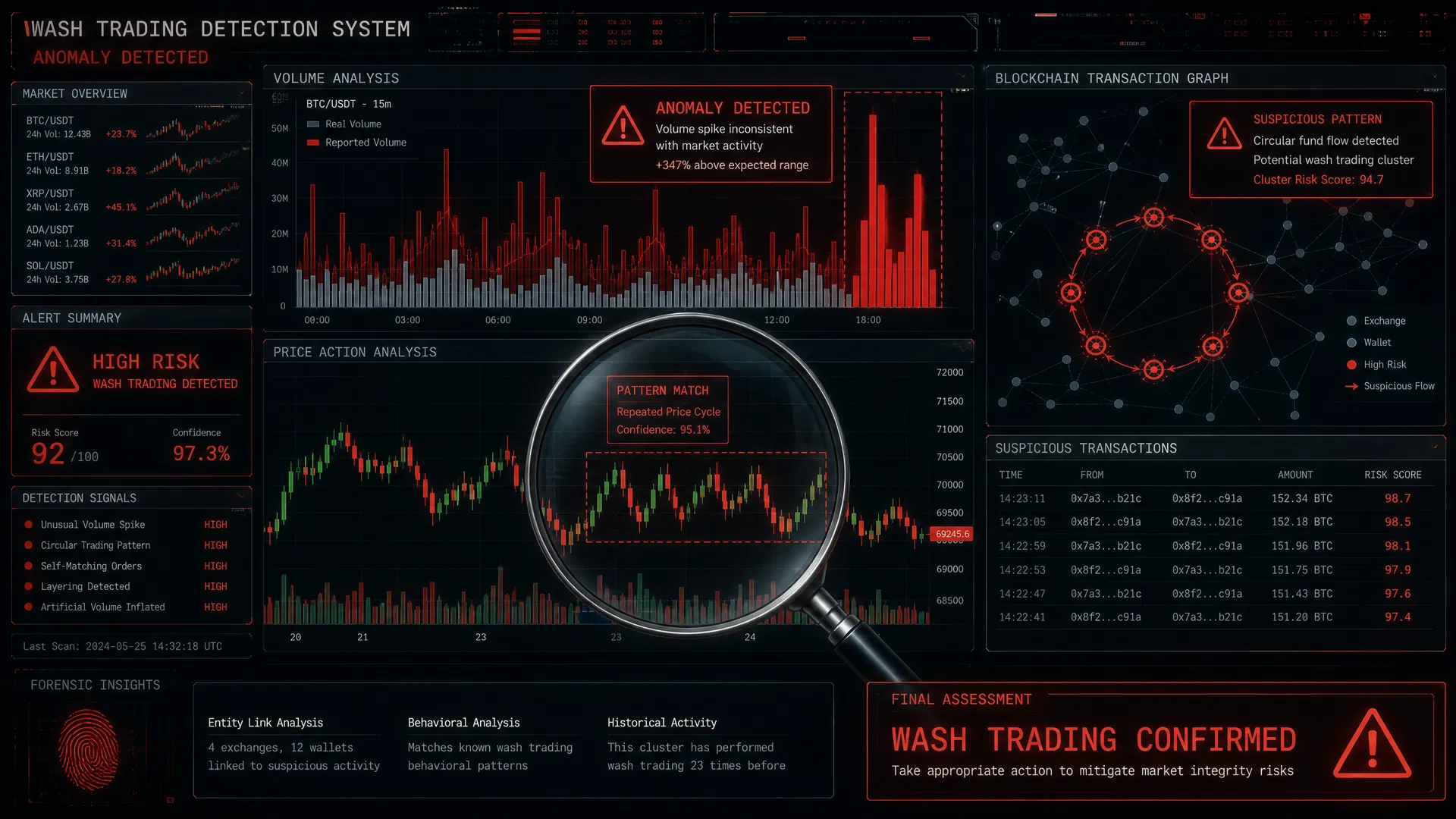
Wash trading — the practice of simultaneously buying and selling assets to create artificial volume — has plagued cryptocurrency exchange rankings since the earliest days of the industry. A 2019 Bitwise report estimated that over 95% of reported Bitcoin volume on unregulated exchanges was fabricated. While the situation has improved, the problem has not disappeared.
ExchangeRank's composite scoring model addresses this directly. Rather than ranking exchanges purely by self-reported 24h volume, our algorithm cross-references volume data with independent web traffic metrics from our proprietary traffic intelligence system. An exchange reporting $10 billion in daily volume but attracting only 50,000 weekly website visitors is a statistical outlier — and our model penalizes it accordingly.
The traffic quality factor (weighted at 20% of the composite score) measures the ratio of volume to visits. Exchanges with a healthy ratio — typically between $1,000 and $5,000 in volume per weekly visitor — score well. Those with ratios 10x or more above the market average are flagged as potential wash traders and receive a significantly lower composite score, regardless of their raw volume.
Volume consistency (15% weight) adds another layer of protection. Legitimate exchanges show relatively smooth volume curves over 30-day periods, with natural peaks around market events. Exchanges that show sudden, unexplained volume spikes — often 5–10x their baseline — without corresponding traffic increases are penalized. This approach has proven effective at surfacing exchanges that consistently rank higher on traffic-adjusted metrics than on raw volume alone.
We believe transparent methodology is essential for building trust in exchange rankings. All scoring weights and data sources are documented on our Methodology page, and we welcome feedback from exchanges and researchers who identify discrepancies in our data.
Related Articles
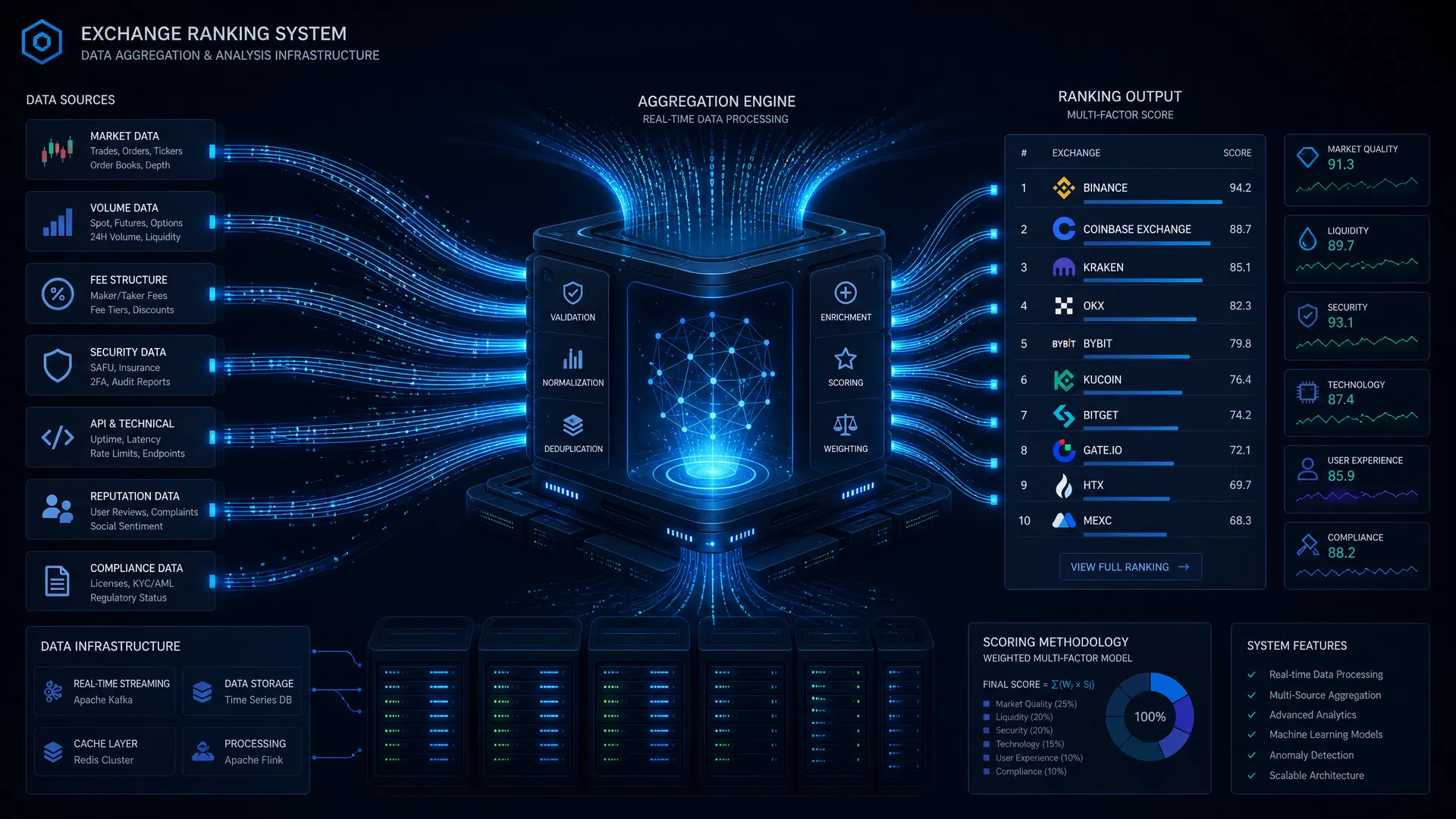
How ExchangeRank Collects and Processes Exchange Data — Our Independent Infrastructure
June 8, 2026 · 7 min read

Which Crypto Exchanges Have Proof of Reserves in 2026?
June 11, 2026 · 11 min read

MEXC Faces U.S. Financial Cutoff Over $16 Billion Allegations—But the Order Is Not Immediate
November 9, 2026 · 5 min read

HTX’s UK Exit Gains Court Backing as FCA Secures Pledge Through 2031
November 2, 2026 · 5 min read