ZondaCrypto Collapse: Poland's Biggest Crypto Exchange Scandal
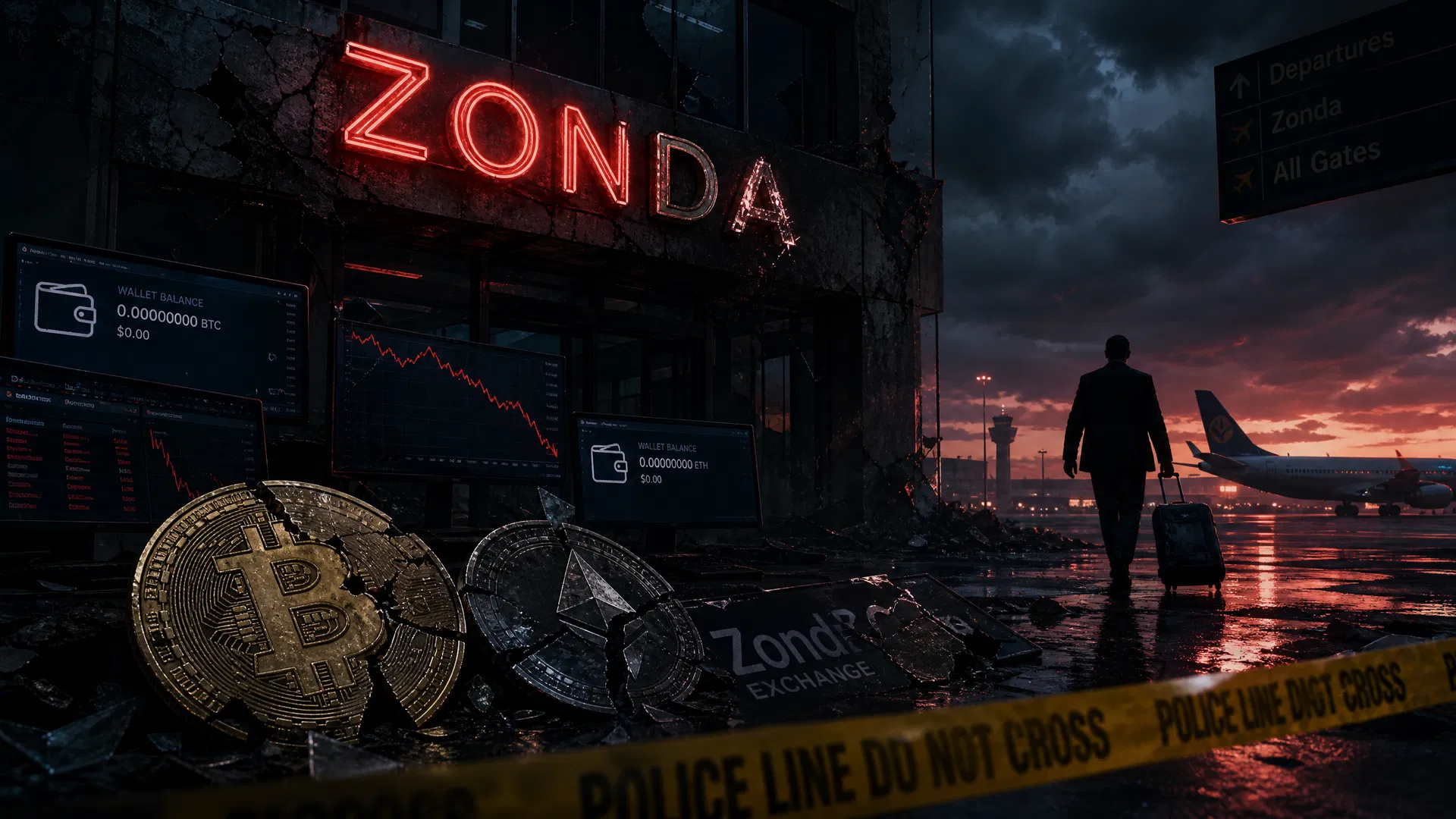
Poland's largest crypto exchange imploded in 2026 after 99.7% of its Bitcoin reserves vanished. CEO Przemysław Kral fled to Israel — a country that does not extradite its own citizens. The exchange's founder, Sylwester Suszek, has been missing since 2022. Prosecutors suspect kidnapping. This is the full story.
From BitBay to ZondaCrypto: Poland's Crypto Giant
In 2014, three friends from Silesia — Sylwester Suszek, Mateusz Bajer and Jacek Rogoż, and a third co-founder — launched BitBay in Katowice, Poland. Within three years, the platform had grown into one of Europe's largest cryptocurrency exchanges, processing over $20 billion in annual trading volume and serving nearly one million registered users. BitBay was Poland's answer to Coinbase: a regulated, user-friendly platform that brought crypto trading to the mainstream Polish market.
Suszek, then in his mid-twenties, became one of Poland's most prominent tech entrepreneurs. He owned luxury properties in Warsaw's prestigious Złota Street district, a helicopter, and a collection of high-end automobiles. He was, by all accounts, a hands-on CEO who genuinely believed in the transformative potential of blockchain technology.
The trouble began in 2018, when Poland's Financial Supervision Authority (KNF) placed BitBay on its public warning list, citing concerns about potential unauthorized payment services. The exchange responded by relocating its operations — first to Malta, then to Estonia, where it obtained an operating license under EU regulations. The relocation was framed as a business decision, but it also placed the exchange beyond the direct reach of Polish regulators.
The Quiet Transfer of Control
In May 2021, BitBay announced it had secured a significant investor from the United States. Suszek stepped down as CEO, and a corporate restructuring began that would, over the following eight months, transfer control of every entity in the BB Trade group to a single individual: Przemysław Kral, a Polish attorney from Bytom.
The restructuring was meticulously documented across four jurisdictions. On June 30, 2021, a newly formed Swiss holding company, Divisio Holding AG — incorporated in Zug just ten days earlier and wholly owned by Kral — acquired BB Trade Pro Limited in England. By November 5, 2021, Kral had assumed the presidency of BB Trade Estonia OÜ, the operating company that held the exchange's EU license. On that same date, the exchange was rebranded from BitBay to ZondaCrypto.
Suszek, for his part, was asking questions. WhatsApp messages later obtained by investigators showed him repeatedly asking Kral and his associate Marian Wszołek — a Silesian businessman with alleged ties to organized crime — whether his personal assets, which had been placed in various corporate structures for tax purposes, were 'safe.' Each time, he was reassured. By January 2022, Kral had formally replaced Suszek as the director of the Czech subsidiary EXPOFÉR SERVIS HOUSE s.r.o., the last formal position Suszek held in the group.
March 10, 2022: The Disappearance
On the morning of March 10, 2022, Sylwester Suszek drove his son to kindergarten in Bytom. He then drove to Czeladź, to the fuel depot and transport base owned by Marian Wszołek — the same man who had introduced him to Kral years earlier, and the same man who had been the last person to see him. Suszek arrived at the depot around 9 a.m. and was last seen between 12:30 and 3 p.m.
The depot's surveillance cameras — covering an expansive complex that included a private helipad where Suszek's helicopter was stationed — were not functioning that day. Wszołek later explained there had been a technical malfunction. Suszek's Porsche Taycan was found at the meeting site. The following day, it was gone. It has never been located.
Tracking dogs lost the scent in a garage on the property. Four days after the disappearance, Suszek's phone registered a signal near the A1 motorway, in a location that made no sense to anyone who knew him. Then the phone went silent. His family reported him missing the same day he disappeared. His sister Nicole has since stated in multiple interviews that she is certain her brother is dead.
Polish prosecutors opened a missing persons investigation. They also opened a separate inquiry into the possibility that Suszek had been kidnapped. Neither investigation has produced an arrest. The case remains officially unsolved.
The Missing Keys: 4,500 Bitcoin and a $330 Million Problem
For four years, ZondaCrypto operated without apparent crisis. Under Kral's leadership, the exchange expanded its sponsorship portfolio aggressively: it became the general sponsor of the Polish Olympic Committee, sponsored Polish football clubs, and entered into partnerships with Italian Serie A clubs Juventus, Bologna FC, and Parma Calcio. The exchange's marketing budget was enormous, its public profile high.
The first signs of trouble emerged in December 2025, when users began reporting on the exchange's official Telegram channel that withdrawal requests were sitting in 'pending' status for days. Management attributed the delays to high demand and new security protocols. The explanations satisfied few.
By late March 2026, a whistleblower website — zonda-alert.pl — had launched to aggregate user complaints. Blockchain analysts at Recoveris followed with hard data: on-chain analysis showed that ZondaCrypto's hot wallet Bitcoin reserves had collapsed from 55.7 BTC in August 2024 to just 0.18 BTC by March 2026 — a 99.7% decline. More alarming still, 511 separate transactions between December 2025 and April 2026 had moved over $21 million across 30 different cryptocurrencies from ZondaCrypto wallets to a single Kraken deposit address.
On April 17, 2026, Kral addressed the allegations publicly. He acknowledged the withdrawal problems and cited a cold wallet holding approximately 4,500 BTC — worth around $330 million at current prices — as proof that the exchange remained solvent. The defense immediately unraveled: Kral admitted that ZondaCrypto could not access those coins. The private key, he explained, belonged to Sylwester Suszek, who had failed to hand it over when he sold the business in 2021. The man who held the key had been missing for four years.
Kral Flees to Israel: The Extradition Problem
Within days of his public statement, Przemysław Kral departed for Israel. Polish media outlet Onet reported that Kral holds Israeli citizenship — a detail that significantly complicates any extradition effort. Israel does not extradite its own citizens under Israeli law, a principle that has historically made the country a destination of last resort for individuals facing criminal proceedings in other jurisdictions.
Polish Deputy Interior Minister Czesław Mróczek acknowledged the complication directly, stating publicly that Poland has no established experience handling extradition requests of this kind. No international arrest warrant or Interpol red notice has been publicly confirmed, leaving the status of enforcement efforts unclear.
A former supervisory board member of ZondaCrypto, Georgi Džaniašvili, stated on social media that despite multiple extraordinary board meetings and direct requests, the board had been unable to obtain 'sufficiently clear, verifiable, and consistent information' from Kral. The entire supervisory board subsequently resigned.
Polish prosecutors identified losses of at least 350 million złoty — approximately $97 million — affecting up to 30,000 users. Prime Minister Donald Tusk escalated the political pressure, telling parliament that ZondaCrypto had made large payments to organizations linked to right-wing politicians, including nearly half a million złoty to the Sovereign Poland Institute, associated with former Justice Minister Zbigniew Ziobro. Tusk also alleged links between ZondaCrypto and the Tambov group, a Russian criminal network — a claim Kral dismissed as 'absurd.'
The Political and Regulatory Fallout
The ZondaCrypto collapse triggered a political firestorm that went well beyond the exchange itself. Poland was, at the time of the collapse, the only EU member state that had not fully transposed MiCA — the bloc's comprehensive crypto-asset regulation — into national law. President Karol Nawrocki had vetoed government crypto regulation bills twice, in December 2025 and February 2026. Tusk alleged that Nawrocki was aware of ZondaCrypto's financial difficulties and political connections when he cast those vetoes.
The legal situation for victims is complicated by the exchange's Estonian operating license, which is recognized across the EU under the single market passport system. Polish regulators had limited jurisdiction over the exchange regardless of whether domestic legislation was in place. As forensic investigator Damian Dejewski noted, 'The key issue is whether there are still assets left and where they are. The money flows between the exchange and related companies remain unclear, and assets may have been systematically moved out for months, perhaps years.'
Polish Olympic athletes are still owed 1.1 million złoty in token-based medal rewards from the exchange's Olympic Committee sponsorship — money that now appears unrecoverable. Multiple football clubs have terminated their sponsorship agreements. The affiliated fintech firm Femion, also controlled by Kral, filed for bankruptcy in May 2026.
The ZondaCrypto case has become a defining moment for crypto regulation in Central Europe. It exposed the limits of the EU's passporting system, the dangers of regulatory arbitrage across jurisdictions, and the catastrophic consequences of allowing a crypto exchange to operate without adequate reserve verification. For the 30,000 users who cannot access their funds, it is also a deeply personal financial disaster — one whose full resolution may depend on whether Polish authorities can ever bring Przemysław Kral back to face justice.
What Happened to Sylwester Suszek?
The question that haunts the entire ZondaCrypto story is the one that may never be answered: what happened to Sylwester Suszek? Polish prosecutors are formally investigating the possibility of kidnapping. His sister believes he was murdered. The organized crime connections that surrounded the exchange — the Pokida gang member who was godfather to Suszek's son, the fuel depot owner with alleged VAT fraud ties, the luxury apartment that inexplicably changed hands to a depot employee after the disappearance — paint a picture of a man who knew too much and was in the wrong company.
The timing of Suszek's disappearance is striking. He vanished nine weeks after Kral formally replaced him as director of the Czech subsidiary — the last formal corporate position he held. He vanished after months of asking whether his personal assets were safe. He vanished at the property of the man who had introduced him to Kral. And he vanished while holding the private keys to 4,500 Bitcoin — a fortune that, at today's prices, is worth over $330 million.
Whether Suszek is dead or alive, whether he was a victim or a participant, whether the missing Bitcoin was stolen or hidden — these questions remain open. What is not in doubt is that his disappearance, and the corporate restructuring that preceded it, created the conditions for one of the largest crypto fraud cases in European history. The cold wallet containing 4,500 BTC sits unmoved on the blockchain, its contents visible to anyone with a block explorer but accessible to no one — a monument to a mystery that Polish justice has yet to solve.
Compare Safe Alternatives to ZondaCrypto
The collapse of ZondaCrypto is a stark reminder that not all cryptocurrency exchanges are created equal. For Polish and European traders who lost access to their funds, the experience underscores the importance of choosing regulated, transparent platforms with proven track records and verifiable proof of reserves.
If you are looking for a safe alternative to ZondaCrypto, the following exchanges offer strong regulatory compliance, transparent operations, and are available to European users. All three are registered with relevant financial authorities and publish regular proof-of-reserves audits.
Kraken is one of the oldest and most trusted cryptocurrency exchanges in the world, founded in 2011. It is regulated in the United States, the European Union, and the United Kingdom, and has never been hacked in its 15-year history. Kraken supports SEPA transfers for European users and offers a wide range of cryptocurrencies with competitive fees.
Bitstamp, founded in 2011 in Slovenia, is Europe's oldest cryptocurrency exchange and one of the most regulated platforms globally. It holds licenses in Luxembourg (EU), the United Kingdom, and the United States. Bitstamp is particularly popular among institutional investors and offers SEPA and SWIFT transfers for European users.
Coinbase is the world's largest publicly traded cryptocurrency exchange, listed on the NASDAQ under the ticker COIN. It is regulated in the United States, the European Union, and the United Kingdom, and is known for its strong security practices and transparent operations. Coinbase supports SEPA transfers and is available in over 100 countries.
Useful Resources
Kraken — Regulated European Exchange
One of the oldest and most trusted exchanges. Regulated in EU, UK, and US. SEPA transfers supported. Never hacked in 15 years of operation.
https://exchangerank.com/exchange/kraken
Bitstamp — Europe's Oldest Crypto Exchange
Founded in Slovenia in 2011. Licensed in Luxembourg (EU), UK, and US. Preferred by institutional investors. SEPA and SWIFT transfers.
https://exchangerank.com/exchange/bitstamp
Coinbase — NASDAQ-Listed Exchange
World's largest publicly traded crypto exchange (NASDAQ: COIN). Regulated in EU, UK, and US. Available in 100+ countries. SEPA transfers supported.
https://exchangerank.com/exchange/coinbase
Related Articles
The TerraUSD Collapse: How an Algorithmic Stablecoin Lost $40 Billion in 72 Hours
May 31, 2026 · 20 min read

MEXC Faces U.S. Financial Cutoff Over $16 Billion Allegations—But the Order Is Not Immediate
November 9, 2026 · 5 min read
HTX’s UK Exit Gains Court Backing as FCA Secures Pledge Through 2031
November 2, 2026 · 5 min read
Binance Restarts Withdrawals After $6.3 Billion Hack—95% Replaced, Not Recovered
November 1, 2026 · 5 min read