Which Crypto Exchanges Are MiCA-Compliant in 2026?
The EU's MiCA regulation is now fully in force, and the July 1, 2026 deadline has ended the transitional period. Only 14 exchanges hold the rarest authorisation — trading platform operation. This guide covers every major exchange with a confirmed MiCA CASP licence, which regulator issued it, and what it means for EU users.
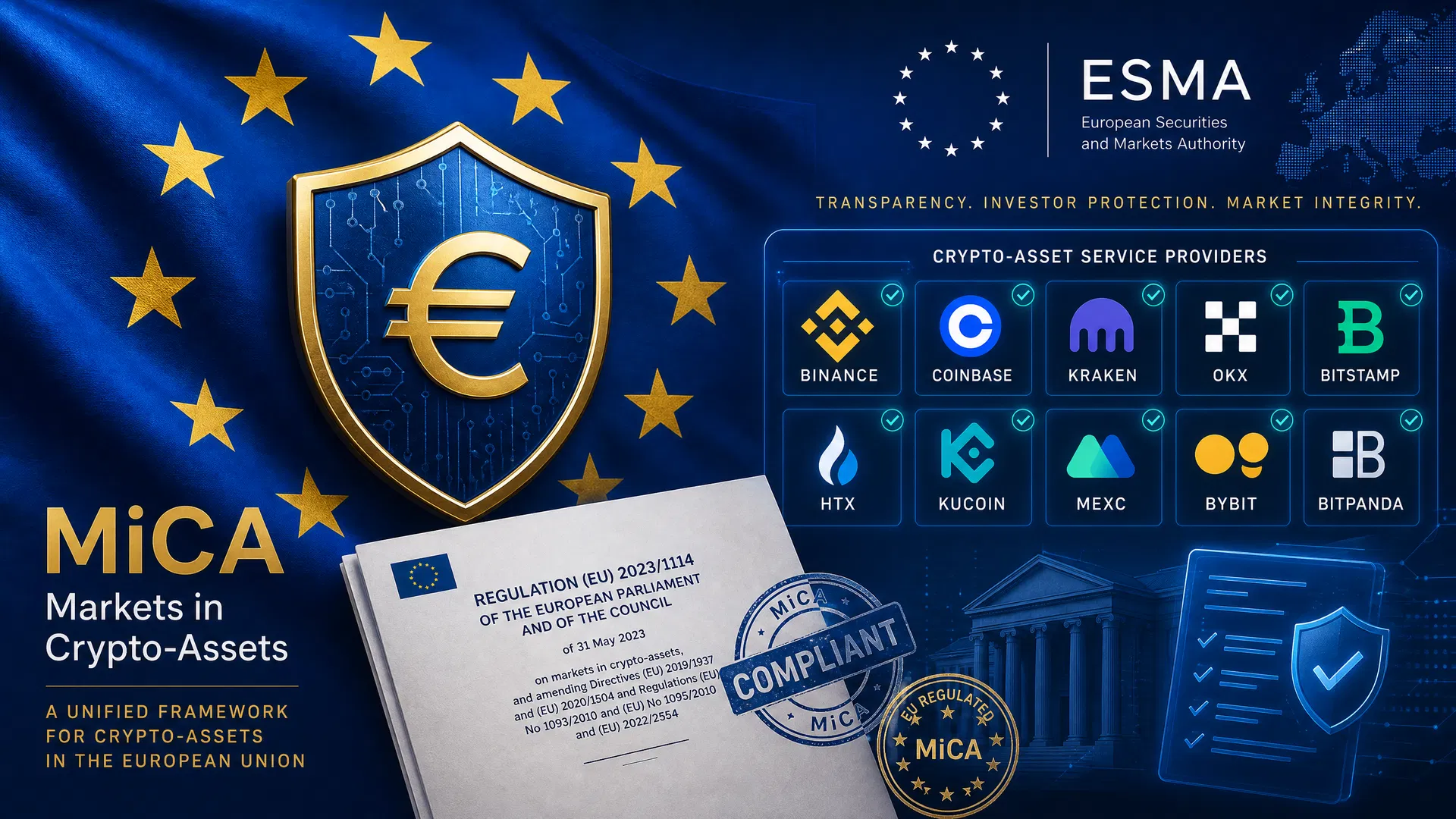
What Is MiCA and Why Does It Matter?
The Markets in Crypto-Assets Regulation — known as MiCA, or formally as Regulation (EU) 2023/1114 — is the European Union's comprehensive legal framework for crypto-asset service providers. Published in the Official Journal of the EU on 9 June 2023, MiCA entered into force on 29 June 2023 and has been phasing in ever since. The final and most consequential phase — the full CASP authorisation regime — became mandatory on 30 December 2024, with a transitional period running until 1 July 2026.
That transitional period has now ended. As of July 1, 2026, any crypto exchange, broker, custodian, or wallet provider operating in the European Union without a valid CASP (Crypto-Asset Service Provider) licence must cease operations immediately. The French financial regulator, the AMF, has explicitly warned that continued unauthorised operation risks criminal prosecution. The era of the unregulated crypto exchange in Europe is over.
For users, MiCA matters for three reasons. First, it provides investor protection: MiCA-licensed exchanges must hold client assets in segregated accounts, maintain adequate capital reserves, and meet strict governance and security standards. Second, it provides regulatory recourse: if a licensed exchange fails, users have legal standing and regulatory channels that simply do not exist with offshore platforms. Third, it provides market access: after July 1, 2026, only MiCA-licensed platforms can legally serve EU residents. Exchanges without a licence are being geo-blocked.
The ESMA (European Securities and Markets Authority) maintains a public register of all authorised CASPs. As of June 2026, 183 entities across 20 EEA member states hold full MiCA authorisation. However, not all authorisations are equal — and the distinction matters enormously for users choosing where to trade.
The Three Tiers of MiCA Authorisation
MiCA creates three classes of CASP authorisation, each with different capital requirements and scope of permitted activities. Understanding these tiers is essential for evaluating what a given exchange's MiCA licence actually covers.
Class 1 (Basic Services, €50,000 minimum capital) covers advisory services, order reception and transmission, execution of orders, portfolio management, and investment advice. This is the most common and least demanding authorisation. Many of the 183 licensed CASPs hold only Class 1 authorisation — meaning they can advise on or transmit crypto orders, but cannot operate a full trading platform.
Class 2 (Custody and Exchange, €125,000 minimum capital) adds custody and administration of crypto-assets, and crypto-to-fiat or crypto-to-crypto exchange services. This covers the core functions of a retail crypto exchange: holding user funds and executing trades.
Class 3 (Trading Platforms, €150,000 minimum capital) covers the operation of a trading platform — an order book or matching engine where buyers and sellers are brought together. This is the rarest and most demanding authorisation. As of June 2026, only 14 of the 183 licensed CASPs hold Class 3 authorisation. These are the platforms that can continue to serve EU users for spot trading after July 1, 2026.
When evaluating a MiCA licence, always check which class of authorisation the exchange holds. A Class 1 licence does not permit the exchange to run a trading platform. The ESMA register specifies the exact services each CASP is authorised to provide.
The 14 Exchanges With Full Trading Platform Authorisation
According to the live ESMA CASP register and confirmed reporting as of June 2026, the following exchanges hold Class 3 MiCA authorisation to operate trading platforms in the EU. These are the platforms that EU users can continue to use after July 1, 2026.
Binance holds a full EU passport for trading platform operation, making it the largest exchange to achieve full MiCA compliance. Binance applied for its licence in Greece and has secured authorisation that covers all 27 EU member states via the MiCA passporting mechanism. Binance has also implemented the required USDT delisting for EU users, replacing it with USDC and EURC.
Coinbase holds a MiCA CASP licence from Luxembourg's CSSF (Commission de Surveillance du Secteur Financier), issued on 20 June 2025. Coinbase Luxembourg S.A. is authorised to provide trading platform services across the entire EEA. As a NASDAQ-listed company, Coinbase was already subject to US SEC reporting requirements; its MiCA licence adds EU-level regulatory oversight.
Kraken holds MiCA licences from both the Central Bank of Ireland (CBI) and Luxembourg's CSSF. The Irish licence, issued on 25 June 2025, covers Payward Global Solutions Limited trading as Kraken (Registration No C559106). Kraken's dual-jurisdiction licensing gives it one of the strongest regulatory footprints of any exchange in Europe.
OKX holds a MiCA CASP licence from the Malta Financial Services Authority (MFSA), issued on 27 January 2025 — one of the first major exchanges to receive full MiCA authorisation. OKX Europe Limited is authorised to provide trading platform services, custody, and exchange services across the EU. Malta has emerged as a key MiCA licensing hub, with 12 authorised CASPs as of June 2026.
Crypto.com holds a MiCA CASP licence from the MFSA, also issued on 27 January 2025, on the same day as OKX. Foris DAX Europe Limited, trading as Crypto.com, is authorised for custody, exchange, and trading platform services. Crypto.com's Malta licence covers all EU member states via passporting.
Bitstamp holds a MiCA CASP licence from Luxembourg's CSSF, issued on 15 May 2025. Bitstamp was the first exchange to receive MiCA authorisation in Luxembourg, and the first crypto exchange in the EU to hold a payment institution licence back in 2016. Bitstamp Europe S.A. is authorised for trading platform operation and has passported its licence across the EU.
Bitpanda holds a MiCA CASP licence from Austria's FMA (Finanzmarktaufsicht), issued in 2025. Headquartered in Vienna, Bitpanda was one of the first European-native exchanges to receive MiCA authorisation. Bitpanda is authorised for trading platform operation, custody, and exchange services.
Bitvavo holds a MiCA CASP licence from the Netherlands' AFM (Autoriteit Financiële Markten). Amsterdam-based Bitvavo is the largest crypto exchange in the Benelux region and one of the first Dutch exchanges to receive full MiCA authorisation. Bitvavo is particularly strong for EUR on-ramps, with native support for iDEAL and Bancontact.
Revolut holds a MiCA CASP licence covering crypto trading services. While primarily known as a neobank, Revolut's crypto trading feature is now MiCA-authorised, allowing EU users to continue trading crypto within the Revolut app after July 1, 2026.
Bybit EU (KuCoin EU / Bybit's European entity) holds a MiCA CASP licence from Austria's FMA. Headquartered in Vienna, Bybit EU operates as a separate, MiCA-compliant entity from the global Bybit platform. Bybit EU is authorised for trading platform operation and has become one of the most popular choices for active European traders due to its competitive fees (0.02% maker / 0.055% taker) and the Unified Trading Account.
eToro holds a MiCA CASP licence from Cyprus's CySEC (Cyprus Securities and Exchange Commission), issued in January 2025. eToro (Europe) Ltd is authorised to provide crypto-asset services across all 30 EEA countries. eToro was one of the first platforms to receive MiCA authorisation, announcing the licence on 19 February 2025.
Gate.com holds a MiCA CASP licence from the MFSA, issued on 1 September 2025. Gate Technology Ltd, the European entity of Gate Group, is authorised for trading platform operation in Malta and across the EU via passporting. Gate.com's MiCA licence was one of the last major exchange authorisations before the July 2026 deadline.
What MiCA Means for USDT and Stablecoins
One of the most significant practical consequences of MiCA for EU users is the delisting of Tether (USDT). Tether declined to apply for MiCA authorisation as an e-money token issuer. Under MiCA, only stablecoins issued by MiCA-authorised entities can be traded on licensed EU platforms. As a result, Coinbase, Kraken, Crypto.com, Binance, and other MiCA-licensed exchanges have blocked EU accounts from trading USDT.
The MiCA-compliant alternatives are Circle's USDC and EURC. USDC (USD Coin) is issued by Circle Internet Financial, which holds MiCA authorisation as an e-money token issuer. EURC is Circle's euro-denominated stablecoin, which is particularly well-suited for EU users. For traders who relied on USDT as a base currency, the transition to USDC or EURC is the most immediate practical change MiCA brings.
The DAC8 regulation, which entered into force on 1 January 2026, adds another layer of compliance. EU-based exchanges are now legally required to automatically report transaction data — including trading volumes, gains, and losses — to national tax authorities. German users' data goes to the Finanzamt; Dutch users' data goes to the Belastingdienst. The era of undisclosed crypto gains in the EU is effectively over.
Exchanges Still Pending MiCA Authorisation
Several major exchanges are operating in the EU under transitional arrangements but have not yet received full MiCA authorisation as of the time of writing. The situation is fluid, and the July 1, 2026 deadline has created significant urgency.
KuCoin has been pursuing MiCA authorisation through Austria's FMA. The exchange's European entity has been operating under transitional provisions, but the status of its full CASP authorisation was pending confirmation as of early June 2026. Users should check KuCoin's official communications for the latest status.
Binance's MiCA journey has been complex. The exchange applied for a licence in Greece — one of the few EU jurisdictions that had not yet issued any CASP authorisations as of early 2026. However, the Yahoo Finance report from June 2026 confirms that Binance has secured a full EU passport, suggesting the Greek application was approved. Users should verify the current status directly with Binance.
MEXC, BingX, and several other Asian-headquartered exchanges have not publicly announced MiCA CASP applications as of June 2026. These exchanges may continue to serve EU users through technical means after July 1, but they would be doing so without legal authorisation. EU users trading on unlicensed platforms after the deadline do so without the investor protections MiCA provides.
How to Verify an Exchange's MiCA Status
The most reliable way to verify whether an exchange holds a valid MiCA CASP licence is to check the ESMA register directly. ESMA maintains a public register at esma.europa.eu that lists all authorised CASPs, their home member state, the services they are authorised to provide, and their passporting notifications. The register is updated weekly.
When checking the register, look for three things: first, confirm the entity name matches the exchange you use (exchanges often operate through subsidiaries with different legal names — for example, Coinbase Luxembourg S.A. rather than Coinbase Inc.); second, check the authorised services to confirm the exchange holds Class 3 authorisation for trading platform operation; third, check the passporting notifications to confirm the licence covers your country of residence.
Several national regulators also maintain their own lists of authorised CASPs. France's AMF publishes a white list of MiCA-licensed exchanges at amf-france.org. Germany's BaFin, the Netherlands' AFM, and Luxembourg's CSSF all publish similar lists. Cross-referencing multiple sources provides the most reliable verification.
ExchangeRank's MiCA filter on the main rankings page shows all exchanges we have confirmed as MiCA-licensed. The filter is updated as new licences are issued and verified against the ESMA register. Exchanges marked with the MiCA badge on their detail pages have confirmed CASP authorisation from a named EU regulator.
The Bigger Picture: What MiCA Changes for Crypto in Europe
MiCA is the most comprehensive crypto regulation in the world, and its full implementation in July 2026 marks a genuine inflection point for the industry. For the first time, crypto exchanges operating in a major economic bloc are subject to the same kind of regulatory oversight — capital requirements, governance standards, investor protection rules, and ongoing supervision — that traditional financial institutions have faced for decades.
The immediate effect is market consolidation. Of the hundreds of exchanges that operated in Europe under old national VASP registrations, only a fraction have converted to full MiCA authorisation. The conversion rate sits at roughly 8% across the continent. Many smaller exchanges have exited the EU market entirely rather than bear the compliance costs.
For users, this consolidation is a mixed blessing. The exchanges that remain are more regulated, better capitalised, and subject to meaningful investor protection rules. But the reduction in competition may, over time, lead to higher fees and less innovation. The MiCA framework is designed to be technology-neutral and to evolve with the market — ESMA is required to review the regulation by 2027 — but the initial effect is a significant reduction in the number of platforms available to EU users.
The global implications are also significant. MiCA's passporting mechanism means that a single licence in one EU member state gives access to all 27 countries — a market of 450 million people. For exchanges that have invested in MiCA compliance, this creates a powerful competitive advantage. For those that have not, it means losing access to one of the world's largest and wealthiest consumer markets. The regulatory standard MiCA sets is already influencing crypto regulation discussions in the UK, Australia, and the United States.
Related Articles
Binance Withdraws MiCA Application in Greece — No EU License as of July 1, 2026
June 24, 2026 · 8 min read
KuCoin.EU and the MiCA Licence — The Full Story: From Vienna to the FMA Ban and Back
June 24, 2026 · 8 min read

Binance on the Brink: Last Days to Secure MiCA Licence — What an EU Ban Would Mean for the World's Largest Exchange
June 21, 2026 · 9 min read

Binance Faces EU Exit as Greece Prepares to Reject Its MiCA Licence Application
June 17, 2026 · 6 min read