USDT Effectively Banned in Europe: Binance, Coinbase and Kraken Restrict Tether Ahead of MiCA Deadline
Europe's three largest crypto exchanges — Binance, Coinbase and Kraken — have restricted or removed USDT access for users in the European Economic Area as the MiCA compliance deadline of July 1, 2026 approaches. Tether has not obtained MiCA authorisation, forcing regulated platforms to phase out the world's largest stablecoin for European customers. Circle's USDC and EURC are emerging as the primary beneficiaries.
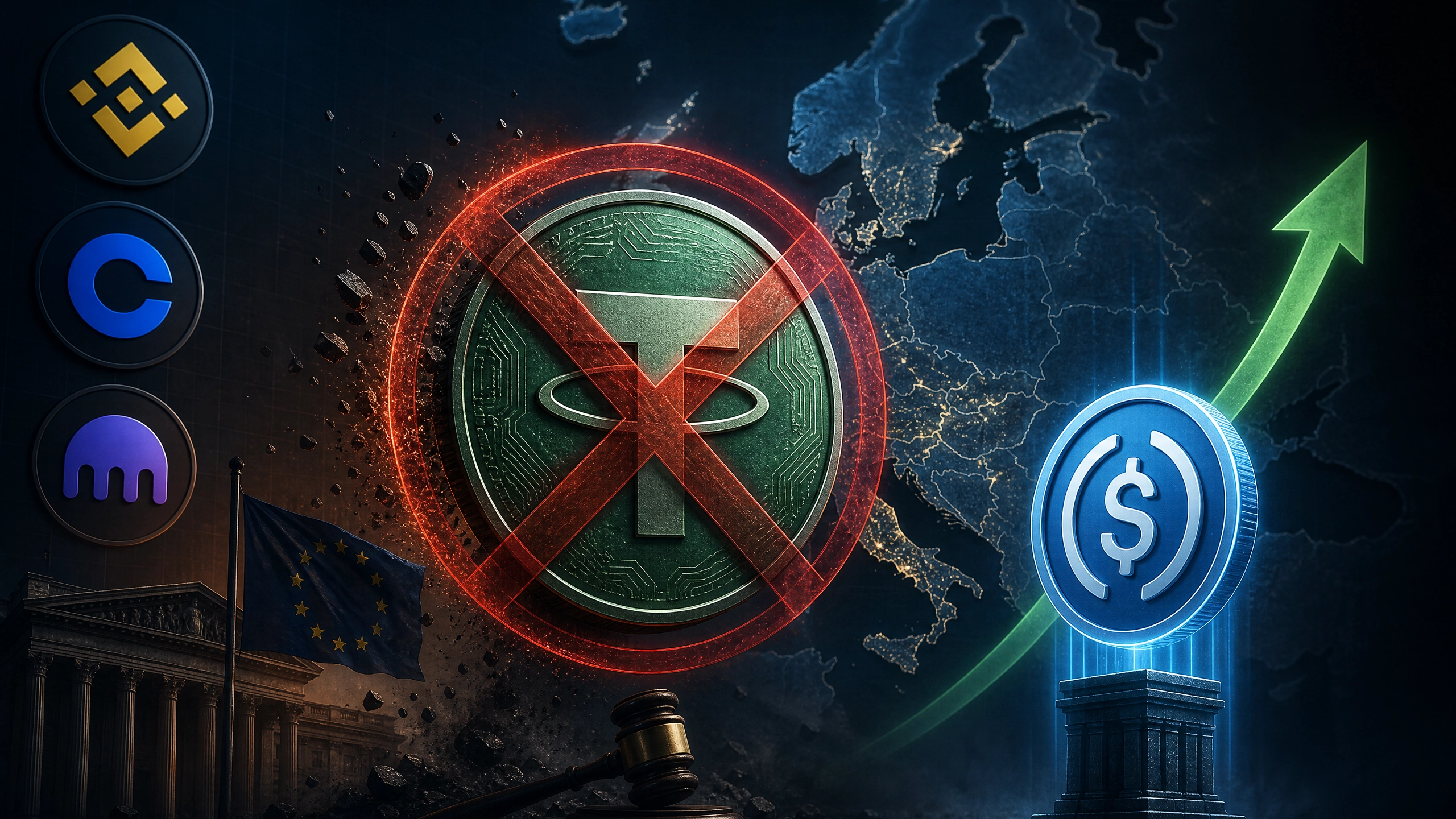
Europe's crypto market is undergoing its most significant structural shift since the introduction of the Markets in Crypto-Assets (MiCA) framework. In the days leading up to the July 1, 2026 compliance deadline, Binance, Coinbase, Kraken and Crypto.com have all adjusted stablecoin access for users in the European Economic Area, effectively restricting or removing USDT — the world's largest stablecoin by market capitalisation — from their European platforms. The move affects tens of millions of European crypto traders who have relied on USDT as the primary vehicle for entering and exiting positions across crypto markets.
The root cause is straightforward: Tether, the issuer of USDT, has not obtained MiCA authorisation for its stablecoin. Under MiCA, stablecoin issuers serving EU customers must meet strict reserve, transparency and licensing requirements, and receive approval as an e-money token issuer or asset-referenced token issuer from a national regulator. Without this approval, regulated exchanges operating in the European Economic Area face significant legal exposure if they continue to offer USDT trading pairs to European users. The result is a regulatory sorting process that is reshaping which assets remain accessible on licensed platforms.
The scale of the MiCA authorisation challenge is evident in the data. As of June 2026, only 183 firms have received full Crypto Asset Service Provider (CASP) authorisation across the EU, with just 14 holding approval to operate trading platforms. Germany leads the bloc with 53 authorised entities. The compliance costs alone — which can reach hundreds of thousands of euros — have pushed smaller firms out of the market entirely, accelerating consolidation around the largest exchanges. The July 1 deadline is the final cliff for providers that have been operating under transitional arrangements since MiCA's phased rollout began in 2024.
For European traders, the practical consequences are immediate. USDT has historically dominated stablecoin trading pairs on major exchanges, providing deep liquidity and tight spreads across thousands of crypto assets. Its restriction means that traders must either migrate to alternative stablecoins, use fiat on-ramps directly, or accept reduced liquidity on certain trading pairs. Binance's EEA stablecoin notice, Coinbase's updated regional policy and Kraken's revised asset availability page have all been updated to reflect the new landscape, with each platform directing users toward compliant alternatives.
The primary beneficiaries of the USDT restriction are Circle's stablecoins: USDC, a dollar-pegged token, and EURC, a euro-denominated stablecoin. Circle has proactively aligned both products with MiCA requirements, securing the necessary authorisations to remain available on licensed European exchanges. This regulatory positioning has given Circle a structural advantage in the European market that Tether currently lacks. Analysts at several crypto research firms have noted that USDC's European market share has grown meaningfully since MiCA's stablecoin provisions came into force in mid-2024, a trend that is likely to accelerate following the July 1 deadline.
It is important to contextualise what this shift does and does not mean. USDT is not disappearing from global crypto markets — it remains the dominant stablecoin worldwide, with daily trading volumes that dwarf all competitors combined. The restrictions apply specifically to regulated platforms operating within the European Economic Area. European users with self-custodial wallets can still hold and transact USDT freely; the limitations apply at the exchange level, where MiCA compliance obligations are enforced. Tether itself has not commented publicly on a timeline for seeking MiCA authorisation, though the company has previously indicated it is monitoring the regulatory landscape.
The broader market effect will depend on how European liquidity reorganises over the coming weeks. If traders rotate smoothly from USDT to USDC and EURC, overall exchange volumes may remain stable while issuer market share shifts. If the transition creates friction — particularly for institutional traders and market makers who use USDT as a settlement layer — there could be temporary spread widening and reduced depth on certain pairs. Several exchanges have indicated they are working to ensure continuity of service by expanding USDC and EURC trading pairs ahead of the deadline.
The USDT situation in Europe is a preview of the broader regulatory consolidation that MiCA is designed to achieve. By requiring both exchanges and stablecoin issuers to meet defined standards, the EU is creating a tiered crypto market in which compliance status becomes the primary determinant of access. For exchanges, this means ongoing investment in licensing and legal infrastructure. For stablecoin issuers, it means that regulatory approval in the EU is now a prerequisite for meaningful European distribution. And for traders, it means that the era of unrestricted access to any asset on any platform — regardless of regulatory status — is drawing to a close in Europe, at least on regulated venues.
Related Articles

OKX Europe Offers 8% on USDT-to-USDC Deposits: How the €3,500 Campaign Works
September 22, 2026 · 10 min read

Binance on the Brink: Last Days to Secure MiCA Licence — What an EU Ban Would Mean for the World's Largest Exchange
June 21, 2026 · 9 min read

Binance Faces EU Exit as Greece Prepares to Reject Its MiCA Licence Application
June 17, 2026 · 6 min read
KuCoin.EU and the MiCA Licence — The Full Story: From Vienna to the FMA Ban and Back
June 24, 2026 · 8 min read